

The Singapore A-Level H2 Mathematics syllabus is widely regarded as one of the more demanding subjects taken by Junior College students. It requires strong analytical thinking, consistent practice, and the ability to apply mathematical concepts to unfamiliar problems.
Unlike earlier levels of mathematics, H2 Math emphasises deeper conceptual understanding and multi-step problem solving. Students are expected not only to know formulas but also to apply them in complex scenarios across pure mathematics and probability topics.
The syllabus covers areas such as functions and graphs, sequences and series, vectors, complex numbers, calculus, probability, and statistics. Among these, vectors and integration are particularly content-heavy topics that require strong conceptual understanding and substantial memorisation.
Many of these topics are interconnected and frequently appear together in exam questions. As a result, students must learn to combine multiple techniques within a single solution.
This is where H2 math tuition becomes valuable. Structured tuition programmes focus on helping students understand difficult concepts, practise exam-style questions, and develop systematic problem-solving methods.
This guide explores the hardest H2 Math topics students struggle with and explains how Andrew Yap Education Centre can help them master these challenging areas.
Key Takeaways:
- H2 Mathematics is significantly more demanding than O-Level maths, requiring strong conceptual understanding and the ability to apply multiple techniques within complex exam questions.
- Students commonly struggle with Vectors and Integration, which are among the most content-heavy topics and require substantial memorisation, along with Functions, Probability, and Permutations and Combinations.
- H2 math tuition provides structured explanations, exam-focused practice, and targeted feedback that help students build confidence and improve accuracy.
- Choosing the right tutor with small class sizes, proven academic results, and strong teaching methods can significantly improve a student’s performance in A-Level mathematics.
Why Many Students Turn to H2 Math Tuition for Difficult Topics

Moving from secondary school mathematics to Junior College mathematics is a significant academic jump. The pace of lectures increases, topics become more abstract, and exam questions demand a higher level of reasoning.
Several factors contribute to the difficulty students face:
- Increased Conceptual Depth: Many H2 Math topics go beyond basic calculations. Students must understand mathematical structures, proofs, and relationships between different concepts.
- Multi-Topic Exam Questions: A-Level questions frequently combine multiple topics. For example, a problem may involve vectors alongside calculus.
- Heavy Content Load: The syllabus contains many formulas, theorems, and techniques that students must remember and apply accurately.
- Limited Time During Exams: Students must learn to solve complex questions efficiently while avoiding careless mistakes.
Because of these challenges, many students seek H2 math tuition to reinforce their understanding. Tuition provides:
- Structured explanations of difficult concepts
- Targeted practice with exam-style questions
- Immediate clarification of doubts
- Guidance on exam strategies and time management
A strong tuition programme focuses not only on solving questions but also on building deeper mathematical thinking.
Hardest H2 Math Topics Students Commonly Struggle With
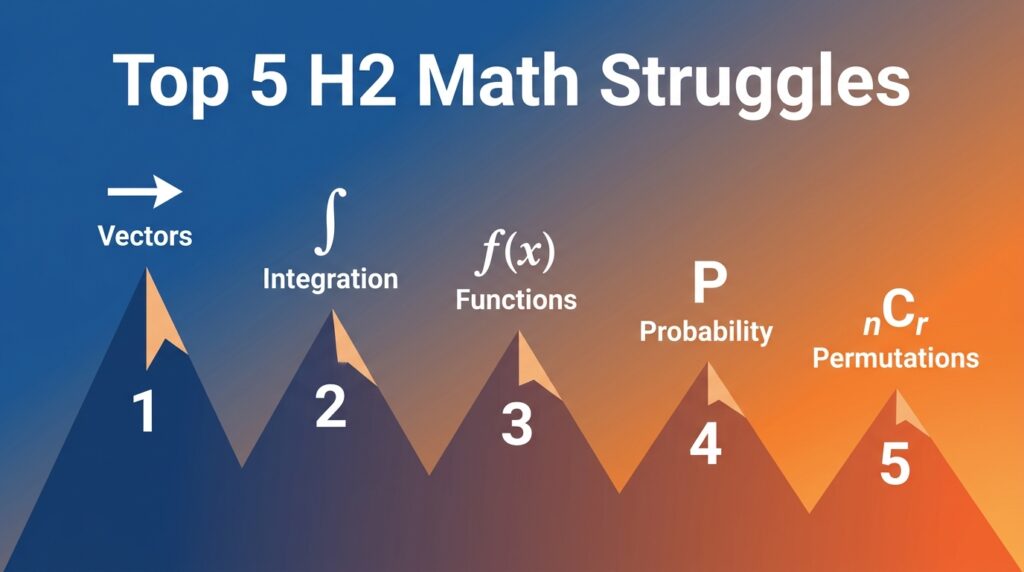
Even capable students find that certain parts of the H2 Mathematics syllabus demand far more effort than others. These topics combine abstract reasoning, multi-step calculations, and the ability to apply several concepts within a single question.
When one area is misunderstood, it often affects performance in other topics as well. Below are some of the hardest H2 Math topics students commonly struggle with, and why many families turn to additional guidance to help students master them.
Vectors: Why Many Students Seek H2 Math Tuition for This Topic
Vectors are often considered one of the most difficult topics in H2 Math. The topic requires students to visualise geometric relationships while performing algebraic manipulations.
In the H2 Math syllabus, vectors involve concepts such as:
- Vector equations of lines and planes
- Scalar (dot) products
- Vector (cross) products
- Angles between lines and planes
- Intersection of lines and planes in three-dimensional space
These ideas are mathematically rich but also challenging to understand without clear visualisation.
Why Students Struggle With Vectors
Several factors make vectors difficult for many students.
First, the topic combines geometry and algebra. Students must interpret spatial relationships while manipulating algebraic expressions.
Second, vector questions often involve multiple steps. Missing one relationship or misinterpreting a vector equation can lead to incorrect answers.
Third, many students struggle with visualising three-dimensional structures from equations alone.
How H2 Math Tuition Helps With Vectors
H2 math tuition often focuses on simplifying vector concepts through structured teaching methods.
For example, tutors may:
- Break down vector problems step by step
- Use diagrams to illustrate geometric relationships
- Teach systematic approaches to solving intersection and angle questions
- Provide exposure to a wide range of exam-style vector problems
With consistent practice and guidance, students gradually develop confidence in interpreting and solving vector problems.
Integration and Applications: A Major Focus in H2 Math Tuition
Integration is one of the most content-heavy topics in H2 Mathematics. Students must remember multiple techniques and recognise when each method should be applied in different types of exam questions.
In H2 Math, integration goes beyond simple antiderivatives. Students must master several techniques and apply them to real mathematical problems.
Key integration techniques include:
- Integration by substitution
- Integration by parts
- Integration using partial fractions
- Definite integrals
Students must also understand applications of integration, such as calculating the area under curves and determining the volume of solids.
Why Integration Is Difficult
Integration presents several challenges.
First, students must remember multiple techniques and recognise when each technique should be used.
Second, integration problems often involve long calculations, increasing the risk of errors.
Third, application questions require careful interpretation of graphs and functions.
How H2 Math Tuition Improves Integration Skills
Many H2 math tuition programmes dedicate significant time to calculus because it forms a core foundation of the syllabus.
Tuition sessions often focus on:
- Recognising patterns that indicate which integration technique to use
- Practising mixed integration problems
- Learning shortcuts and exam strategies
- Developing accuracy in long calculations
Through repeated practice and feedback, students become more comfortable with complex integration questions.
Functions and Graph Transformations: How H2 Math Tuition Simplifies Them
Functions form one of the earliest topics students encounter in H2 Mathematics, yet they remain conceptually challenging.
The topic covers areas such as:
- Composite functions
- Inverse functions
- Domain and range
- Graph transformations
Although these ideas appear simple at first glance, exam questions often combine multiple concepts.
Why Functions Can Be Confusing
One reason students struggle with functions is the abstract nature of the topic. Understanding how functions behave requires strong conceptual thinking.
Graph transformations also require students to visualise how equations affect the shape and position of graphs.
In exam settings, questions may combine functions with calculus or algebra, increasing complexity.
How H2 Math Tuition Helps Students Master Functions
Through H2 math tuition, students learn to approach function problems systematically. Tutors often focus on:
- Visual explanations of graph transformations
- Step-by-step analysis of composite and inverse functions
- Practice with exam-style graph interpretation questions
This structured approach helps students build confidence and avoid common mistakes.
Probability: Why Students Often Need H2 Math Tuition
Probability forms a major part of the H2 Math syllabus, particularly in the statistics component of the A-Level examination.
Students encounter concepts such as:
- Conditional probability
- Independent events
- Probability distributions
- Venn diagrams involving 3 sets
Probability questions frequently appear in real-world contexts, requiring careful interpretation before calculations begin.
Why Probability Questions Are Challenging
Many students find probability difficult because of the language used in questions.
Word problems often describe complex scenarios involving multiple events. Students must translate these descriptions into mathematical expressions.
Another challenge is distinguishing between similar formulas. Misunderstanding whether events are independent or conditional can lead to incorrect answers.
How H2 Math Tuition Improves Probability Skills
H2 math tuition programmes often teach structured frameworks for solving probability problems.
This includes:
- Identifying key information in word problems
- Drawing diagrams such as tree diagrams or Venn diagrams
- Applying probability formulas systematically
- Practising common exam question patterns
Advanced exam questions may even combine different mathematical topics, requiring students to break complex problems into manageable steps.
With practice, students develop stronger logical reasoning and confidence in tackling probability questions.
Permutations and Combinations: Another Topic Where H2 Math Tuition Helps
Permutations and combinations form an important part of probability topics in H2 Mathematics. These concepts focus on counting techniques and require students to understand when order matters and how restrictions affect possible outcomes.
Key concepts include:
- Factorials
- Permutations (arrangements)
- Combinations (selections)
- Problems involving restrictions or conditions
Why Students Struggle With Counting Techniques
The difficulty often lies in identifying which formula applies to a particular problem.
For example, students must decide whether order matters in a scenario. They must also consider restrictions such as repeated items or position constraints.
Word problems may contain hidden conditions that make the counting process more complex.
How H2 Math Tuition Strengthens Counting Skills
Through H2 math tuition, students learn structured approaches to solving counting problems.
Tutors often teach strategies such as:
- Breaking problems into smaller steps
- Identifying whether order matters
- Using diagrams or tables to organise possibilities
Regular practice helps students develop intuition for choosing the correct counting method.
Study Strategies That H2 Math Tuition Teaches Students

Beyond individual topics, H2 math tuition also focuses on developing effective study habits. Our experienced tutors at Andrew Yap Education Centre often guide students in areas such as:
Understanding Concepts Before Memorisation
Rather than memorising formulas blindly, students learn the reasoning behind mathematical techniques.
Practising Exam-Level Questions
Consistent exposure to challenging questions prepares students for the difficulty of A-Level examinations.
Analysing Mistakes
Reviewing incorrect answers helps students identify weaknesses and avoid repeating errors.
Managing Time During Exams
Learning how to allocate time effectively is crucial for completing long exam papers.
These strategies help students improve not only their mathematical knowledge but also their overall exam performance.
How to Choose the Right H2 Math Tuition Programme
Selecting the right H2 math tuition programme can make a significant difference in a student’s learning experience.
Here are some factors to consider:
- Tutor Experience: Look for tutors who are familiar with the Singapore A-Level syllabus and exam requirements.
- Teaching Method: Effective tutors simplify complex topics and encourage logical problem solving rather than rote memorisation.
- Class Size: Smaller classes often allow for more personalised attention.
- Practice Materials: Quality tuition programmes provide exam-style questions, revision notes, and structured practice sessions.
Choosing a programme that emphasises both conceptual understanding and exam preparation can help students achieve stronger results.
When Should Students Start H2 Math Tuition?
Many students wait until their grades decline before seeking additional support. However, starting H2 math tuition earlier can offer several advantages, such as:
- Early Reinforcement of Concepts: Students can address misunderstandings before they become major problems.
- Consistent Practice: Regular practice helps students keep pace with the syllabus.
- Better Exam Preparation: Students who start early have more time to refine their problem-solving techniques before A-Level examinations.
Signs that a student may benefit from tuition include:
- Difficulty understanding lecture material
- Falling behind in tutorials
- Low scores in internal assessments
Early support can help students regain confidence and stay on track academically.
How H2 Math Tuition Helps Students Master Difficult Topics

H2 Mathematics is a demanding subject that requires both conceptual understanding and strong problem-solving skills.
Topics such as vectors, integration, functions, probability, and permutations and combinations often present significant challenges for students.. These areas involve complex reasoning, detailed calculations, and careful interpretation of exam questions.
With the right guidance, however, these challenges can become manageable. H2 math tuition provides structured explanations, targeted practice, and expert guidance that help students build a strong mathematical foundation. Through consistent learning and practice, students can improve their understanding, develop confidence, and perform better in their A-Level examinations.
For many students, the combination of classroom learning and well-structured tuition creates the support system needed to succeed in one of the most challenging subjects in Junior College. Give us a call today at Andrew Yap Education Centre to learn more about how we guide students through H2 math tuition.
Frequently Asked Questions
Is H2 Math tuition worth it in Singapore?
For many students, H2 math tuition provides structured support that complements classroom learning. Tuition helps students clarify difficult concepts, practise exam-style questions, and receive immediate feedback. In Singapore’s competitive education system, additional guidance can improve confidence and academic performance before A-Level examinations.
How much does H2 math tuition cost in Singapore?
Tuition fees vary depending on class size, tutor experience, and whether lessons are conducted one-to-one or in small groups. Some tuition centres report group classes costing around SGD 1,440 to SGD 1,560 per term for JC H2 Math programmes. Fees may be higher for individual lessons with experienced tutors.
How many hours of H2 Math tuition should a student take each week?
Most JC tuition centres recommend one weekly lesson lasting about two hours. During examination periods, students may increase lessons to two sessions per week to reinforce difficult topics and practise past examination papers.
Can students improve their H2 Math grades within a few months?
Improvement is possible when students receive targeted guidance and practise consistently. Many tuition programmes focus on identifying weak topics first, then reinforcing them through structured exercises and exam-style questions. Progress often depends on the student’s discipline and willingness to practise regularly.
Do students need Additional Mathematics to cope with H2 Math?
Many H2 Math concepts build on Additional Mathematics topics such as differentiation, logarithms, and partial fractions. Students without an A-Math background may need extra support to bridge these gaps before tackling advanced JC topics. Structured tuition can help students review these foundations while learning the new syllabus.