

For many parents in Singapore, the transition from lower secondary to upper secondary mathematics can feel like navigating a maze without a map. With the full implementation of Full Subject-Based Banding (Full SBB) from 2024, terms like “Express” and “Normal Academic” have been replaced by G1, G2, and G3 levels, adding a new layer of confusion to an already stressful subject selection process.
If you are currently asking, “Should my child take g3 additional math?”, you are asking the right question. This subject is a critical gatekeeper for Junior College (JC) science streams and many polytechnic engineering courses. However, it is also known for a steep learning curve that catches many students off guard in Secondary 3.
In this guide, we’ll give you a clear, honest roadmap. We will break down exactly what G3 Additional Mathematics involves, provide a practical checklist to decide if your child is ready, and offer a month-by-month action plan to ensure they don’t just survive the subject, but excel in it.
What Is G3 Additional Mathematics in Singapore?
To understand G3 Additional Mathematics, we first need to look at the Full Subject-Based Banding (Full SBB) system that is now standard across all secondary schools in Singapore. Under this system, subjects are offered at three levels of difficulty: G1, G2, and G3.
G3 (General 3) is the most rigorous level. In the previous system, this was equivalent to the Express stream standard. It is designed for students who have a strong aptitude for the subject and are likely aiming for university pathways that require deep analytical skills.
Additional Mathematics (A-Math) is an elective subject offered at the upper secondary level (Secondary 3 and 4). Unlike Elementary Mathematics (E-Math), which is compulsory, A-Math is optional. It focuses on equipping students with the mathematical foundations necessary for higher studies in science, engineering, and technology.
In technical terms, the syllabus codes you need to know are:
- Syllabus 4049: This is the code for G3 Additional Mathematics. It is the standard O-Level equivalent syllabus.
- Syllabus 4051: This is the code for G2 Additional Mathematics (formerly N(A) Level A-Math).
Think of G3 A-Math as the bridge between standard school math and the advanced mathematics taught at the A-Levels (H2 Math) or polytechnic engineering diplomas. It introduces abstract concepts that go beyond simple calculation, requiring students to prove, derive, and model complex situations.
G3 vs G2 Additional Math — What’s the Actual Difference?
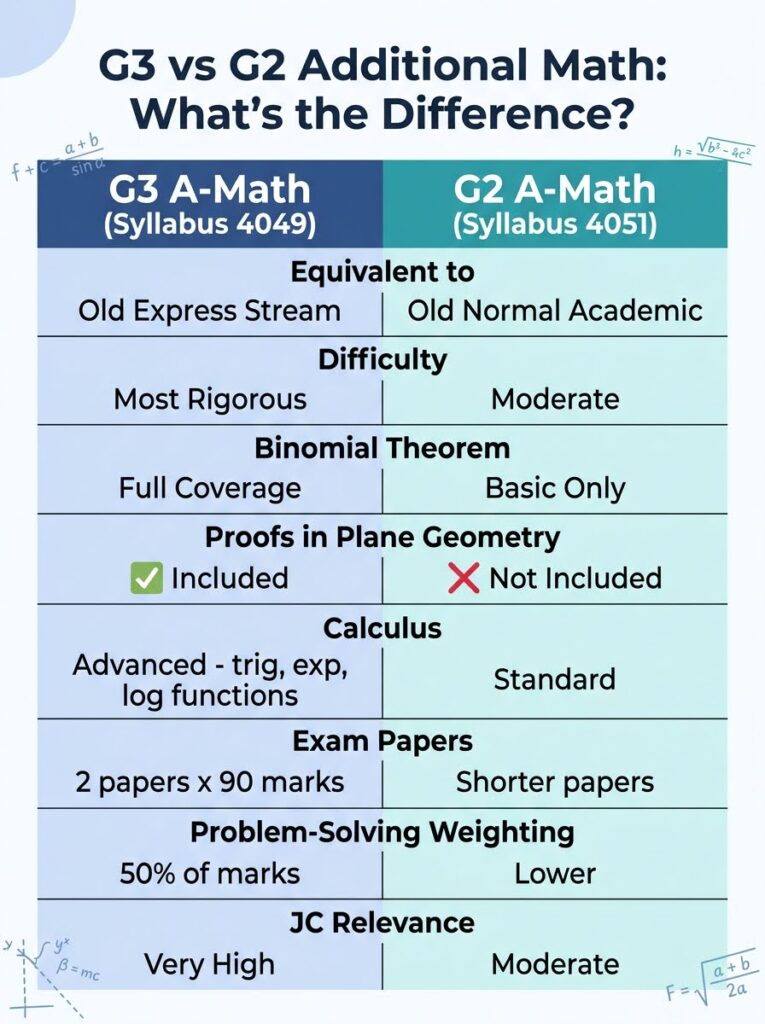
One of the most common questions we receive at Andrew Yap Education Centre is about the difference between G3 and G2 Additional Math. While both subjects cover similar core areas like algebra and calculus, the depth, complexity, and assessment rigour differ significantly.
Here is a detailed comparison to help you understand what your child is signing up for:
| Feature | G3 A-Math (Syllabus 4049) | G2 A-Math(Syllabus 4051) |
| Difficulty Level | High (Most Rigorous) | Moderate |
| Equivalent To | Old Express Stream | Old Normal (Academic) Stream |
| Binomial Theorem | Full coverage (including general terms and proofs) | Basic coverage only |
| Calculus Depth | Advanced (includes trigonometric, exponential, and logarithmic functions) | Standard (polynomials only) |
| Proofs in Plane Geometry | ✅ Included (Required) | ❌ Not Included |
| Paper Length & Format | Two papers, 2h 15m & 2h 30m (90 marks each) | Shorter duration, fewer marks |
| AO2 Weighting (Problem Solving) | Higher (~50%) | Lower (Focuses more on routine skills) |
| JC Eligibility | Directly prepares for H2 Math | Bridge course often required for H2 Math |
Key Takeaway: G3 A-Math is not just “more math.” It includes entire topics (like Geometry Proofs) that G2 does not. This is why students who switch from G2 to G3 often struggle without significant bridging support.
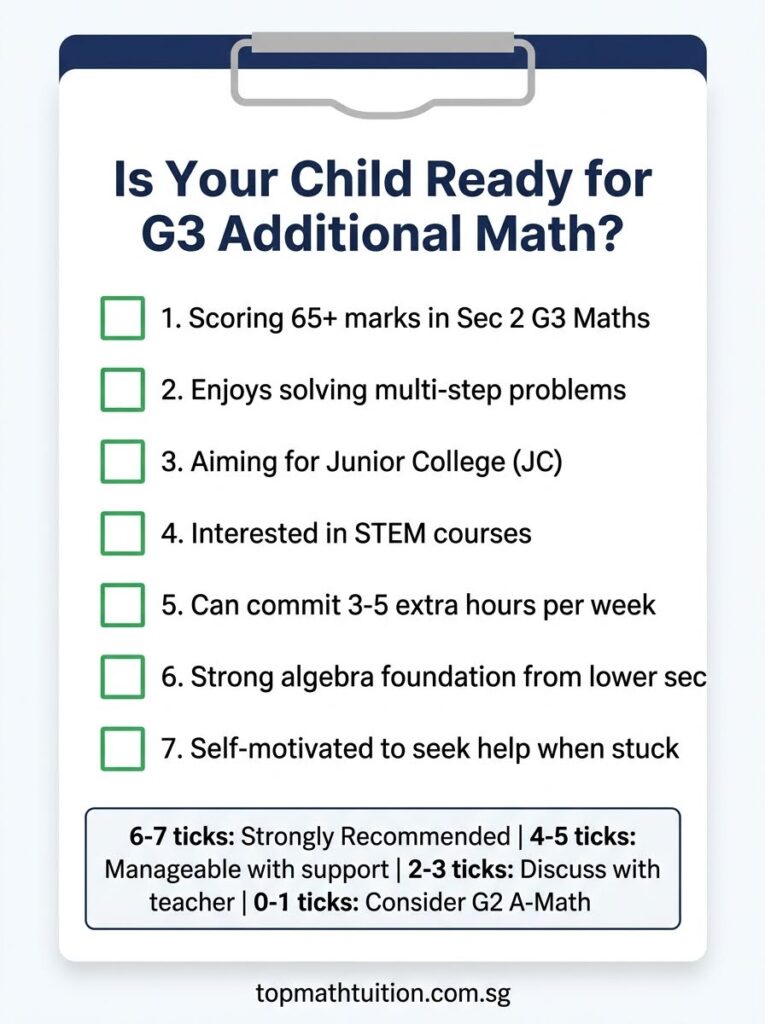
Should Your Child Take G3 Additional Math? (Parents’ Readiness Checklist)
Just because your child can take G3 Additional Math doesn’t always mean they should. It is a demanding subject that requires consistency and resilience. We have developed this readiness checklist based on years of observing student performance at our centre.
G3 Additional Math Syllabus — What Will Your Child Actually Learn?
The G3 A-Math syllabus is split over two years. Understanding this flow helps you anticipate when the workload will peak.
Secondary 3 Topics (Building the Foundation)
The first year focuses heavily on Algebra. If your child’s algebra is weak, Sec 3 will be a struggle.
- Quadratic Functions: Beyond solving equations, students learn about discriminants, maximum/minimum points, and sketching curves.
- Equations & Inequalities: Solving complex inequalities and simultaneous equations involving linear and non-linear terms.
- Surds (Roots): Working with irrational numbers like √2 without using a calculator to find decimal values.
- Polynomials & Partial Fractions: Long division of algebra and breaking complex fractions into simpler parts.
- Binomial Expansions: Expanding brackets with high powers (e.g., (x + y)¹⁰) using formulas rather than manual multiplication.
- Exponential & Logarithmic Functions: The language of growth and decay, crucial for science subjects.
Secondary 4 Topics (Advanced Concepts)
The second year introduces Calculus and advanced Geometry, which are often conceptually harder.
- Trigonometric Functions, Identities & Equations: Much deeper than Sec 2 trig. Includes proving identities (e.g., sinZx + cosZx = 1) and solving wave equations.
- Coordinate Geometry: Analyzing geometric shapes on a graph using algebra (circles, straight lines, quadrilaterals).
- Proofs in Plane Geometry (G3 Exclusive): Using strict logical reasoning to prove properties of circles, tangents, and chords. No numbers, just logic.
- Differentiation (Calculus): Calculating rates of change, gradients of curves, and optimization (finding max/min areas or volumes).
- Integration (Calculus): The reverse of differentiation, used to find areas under curves.
The 4 Hardest Topics in G3 A-Math (And What Parents Should Watch For)
Every year, we see students stumble on the same four topics. Knowing these in advance allows you to monitor your child’s progress more effectively.
1. Differentiation & Integration (Calculus)
This is the “big boss” of A-Math. While the basic rules are learnable, the application questions (Kinematics, Rates of Change) require students to translate word problems into mathematical models. Many students fail not because they can’t integrate, but because they don’t understand what the question is asking.
2. Proofs in Plane Geometry
Unique to the G3 syllabus, this topic is purely logical. Students cannot “calculate” their way out of it. They must derive a proof using rigorous geometric properties. It requires a shift in mindset that many calculation-focused students find frustrating.
3. Binomial Theorem
This is often the first “wall” students hit in Secondary 3 (usually around April/May). The notation involves factorials (!) and combinations (nCr), which looks like a foreign language to beginners. If a student gets lost here, their confidence often takes a massive hit before the mid-year exams.
4. Trigonometric Identities
Unlike lower secondary trigonometry (SOH CAH TOA), this topic involves memorising and applying extensive lists of formulas (e.g., double-angle and addition formulas). The challenge is knowing which formula to apply to solve a puzzle-like proof.
How G3 Additional Math Affects Your Child’s Post-Secondary Options
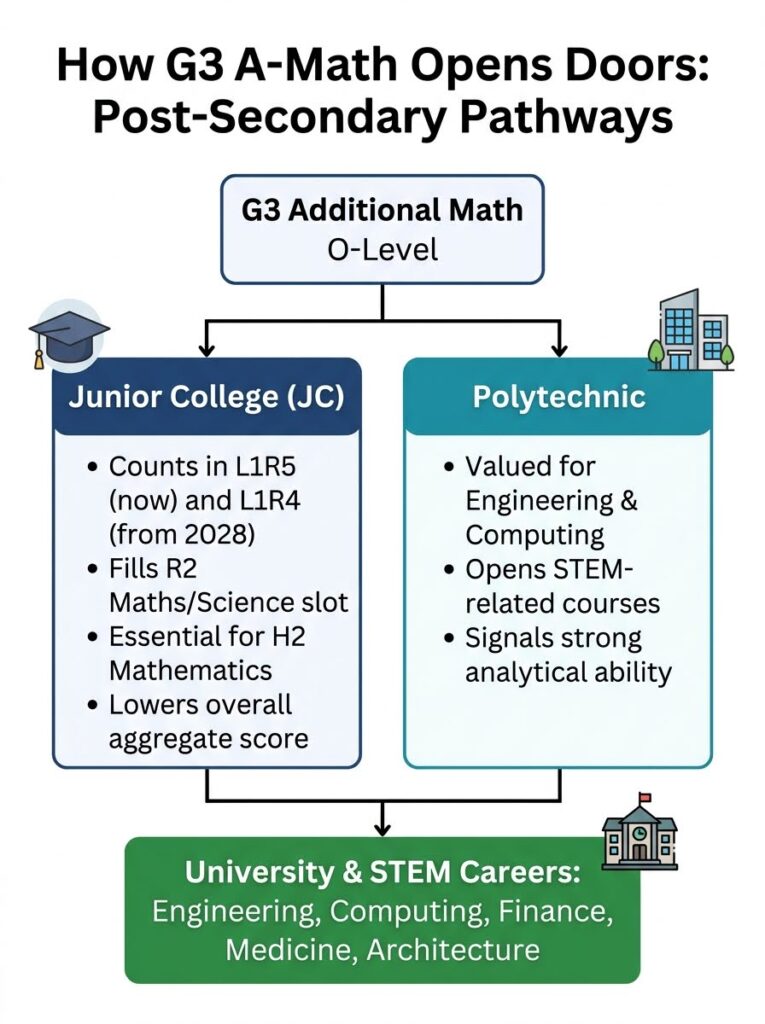
Your child’s subject combination directly influences their admission score for Junior College (JC) or Polytechnic.
JC Admission: L1R5 vs. L1R4
Currently, JCs use the L1R5 scoring system (First Language + 5 Relevant Subjects). From 2028 onwards, this will shift to L1R4.
- A-Math is a “Relevant” Subject: In both systems, A-Math counts as a relevant subject (R2 – Math/Science).
- Double Math Advantage: A student taking both E-Math and A-Math has two chances to score well in the Math/Science category. The system automatically picks the best score.
- Prerequisite for H2 Math: Most JCs require a pass (often a B3 or better) in G3 A-Math to offer H2 Mathematics. H2 Math is a prerequisite for University courses in Engineering, Data Science, Economics, and Sciences. Without G3 A-Math, your child’s subject choices in JC will be severely limited.
Polytechnic Pathways
For Polytechnic admissions (ELR2B2), A-Math is a key subject for the “R2” (Relevant 2) component for courses in:
- Engineering (Aerospace, Civil, Mechanical, etc.)
- Information Technology & Cybersecurity
- Life Sciences & Chemical Engineering
Even if not strictly compulsory for admission, students without A-Math background often struggle significantly in the first year of these polytechnic courses as the math modules assume A-Math knowledge.
Month-by-Month Action Plan for Sec 3 G3 A-Math (For Parents)
Use this timeline to keep your child on track during their critical Secondary 3 year
| Month | Topic Focus / Milestone | Parent Action |
| January | Quadratic Functions & Inequalities | Ensure homework is submitted on time. Watch for confusion regarding “discriminants.” |
| February | Surds & Indices | Check if they are relying too much on the calculator. They must show working. |
| March | Polynomials | First Checkpoint: If Common Test marks are <55%, seek help immediately. |
| April | Binomial Theorem | Critical Period. This is a high-risk topic. Ensure they understand the “general term” formula. |
| May | Mid-Year Exams | Review the paper. Don’t just look at the score; look at where marks were lost (carelessness vs. lack of understanding). |
| June | Holidays / Catch-up | If they failed MYE, use June for intensive revision or a crash course. Do not let gaps linger. |
| July | Logarithms & Modulus Functions | These topics are abstract. Encourage them to practice standard textbook questions until fluent. |
| August | Trigonometric Functions | Memorization of graphs (sin, cos, tan) is key here. |
| September | Coordinate Geometry | Check for understanding of “circles” questions. |
| October | End-of-Year Exams Revision | Start doing full timed practice papers, not just topical drills. |
| November | Final Exams | Celebrate the effort regardless of the result. Analyze the paper to plan for Sec 4. |
5 Ways Parents Can Support Their Child in G3 A-Math (Without Being a Math Expert)
You don’t need to know calculus to help your child succeed. Here are five practical support strategies:
Create a “Output” Study Routine: Math is not studied by reading; it is studied by doing. Ensure your child has a distraction-free hour set aside specifically for practicing questions, not just reading notes.
The “Teach Back” Method: Ask your child to explain a concept to you in simple terms (e.g., “How do you know if a curve is happy or sad?”). If they can’t explain it simply, they don’t understand it well enough.
Monitor Test Scores Early: Don’t wait for the Mid-Year Exam result. Ask to see small topical tests. A string of borderline passes (50-55%) is a red flag that foundations are shaky.
Use Official Resources: Ensure they are practicing with official SEAB / Cambridge past-year papers (Ten Year Series) once they have covered enough topics. The phrasing in official exams differs from textbook drills.
Consider Specialist Tuition Early: If your child scores below 60% in Term 1 or 2, consider enrolling them in a specialist G3 A-Math tuition programme. Remedying gaps in Sec 3 is far easier (and cheaper) than panic-tuition in Sec 4.
What to Look for in a G3 Additional Math Tutor in Singapore
Not all math tuition is created equal. A-Math requires a tutor who understands the specific rigor of the G3 syllabus.
When looking for a tutor, check for:
- Specific G3 Syllabus Experience: Ensure they are teaching the 4049 syllabus, including the new requirements for geometric proofs.
- Small Class Sizes: A-Math problems are complex and often require 1-on-1 explanation of mistakes. Large lecture-style classes often fail to address individual misconceptions.
- Structured Materials: The tutor should provide summary notes that condense the heavy textbook content into digestible formulas and methods.
- Proven Track Record: Ask for results specifically for Upper Secondary A-Math, not just general math improvement.
Frequently Asked Questions About G3 Additional Math
Can my child switch from G2 to G3 A-Math after starting Sec 3?
Technically yes, through a process called “lateral transfer,” but it is rare and difficult. The student must demonstrate exceptional performance in G2 math and usually pass a rigorous qualifying test. It is better to start in G3 if capable.
Is G3 A-Math compulsory?
No, it is an elective subject. However, it is strongly recommended for students intending to pursue Science streams in Junior College.
What score in Sec 2 G3 Math is needed to take G3 A-Math?
Most schools require at least 65-70% in Secondary 2 Mathematics to offer A-Math. Some elite schools may set the bar higher at 75%.
Does G3 A-Math appear on the O-Level certificate?
Yes, it appears as “Additional Mathematics” and is graded separately from Elementary Mathematics. It counts as a full subject for L1R5/L1R4 aggregates.
Is G3 A-Math harder than H2 Maths at JC?
H2 Math is significantly harder and faster-paced than G3 A-Math. G3 A-Math covers about 40% of the foundation needed for H2 Math. Without G3 A-Math, H2 Math is nearly impossible to cope with.
How many hours per week should my child study G3 A-Math?
Beyond school hours and tuition, a student should spend at least 3-4 hours per week purely on independent practice to maintain an ‘A’ grade standard.
What is the pass rate for G3 A-Math at O-Levels?
National distinction rates (A1/A2) for A-Math are typically quite high (often around 40-50%) because the cohort taking it is already self-selected and academically stronger.
However, the failure rate for unprepared students is also real.
Conclusion
G3 Additional Mathematics is a challenging but rewarding subject. It opens doors to the most competitive courses in Junior Colleges and Polytechnics and builds problem-solving resilience that serves students for life. While the jump from Secondary 2 Math is steep, it is entirely manageable with the right mindset, consistent habits, and timely support.
Don’t wait for the first failing grade to take action. If you believe your child has the potential to excel in G3 A-Math, give them the support they need from day one. Contact Andrew Yap Education Centre today or visit us at Block 302, #01-1842, Ang Mo Kio Ave 3, Singapore 560302 for expert guidance, comprehensive notes, and a proven track record.