

If you are a Sec 4 student preparing for O-Level Maths, the biggest mistake is not a lack of effort. It is a lack of structure.
Many students wait until June to “get serious”, panic after prelims, then spend the final weeks doing random papers without fixing the weaknesses that actually cost marks. A better approach is to prepare in phases: build foundations early, strengthen application skills in the middle of the year, and sharpen exam performance closer to the papers.
That is also why a structured roadmap matters for O Level Math Tuition in Singapore so much. At Andrew Yap Education Centre, the emphasis is on progressive learning: securing the fundamentals first, then moving students towards stronger application, accuracy, and exam readiness.
Founded in 2010 by Mr Andrew Yap and Mrs Jasmine Yap, both former subject heads at Hwa Chong Institution, Andrew Yap Education Centre has built its approach around exactly this kind of long-term academic progression.
Key Takeaways:
- Strong O-Level Maths results come from consistent practice, error correction, and timed exposure, not last-minute cramming.
- The year should be split into phases: foundations, application, full-paper practice, and final sharpening.
- If you keep repeating the same mistakes or cannot apply concepts to unfamiliar questions, structured O Level Math Tuition in Singapore can help close the gap faster.
Why Most Sec 4 Students Struggle With O-Level Maths Preparation

Most students do not struggle because they are “bad at maths”. They struggle because their revision is reactive. They revise the topics they like, postpone the ones they fear, and confuse reading notes with actual preparation.
According to SGSchoolKaki, which compiles MOE/SEAB data, 87.7% of candidates scored at least five O-Level passes in 2024. That sounds encouraging, until you remember the remaining 12.3% did not make it. The difference is rarely raw ability. It is a preparation strategy.
Reactive revision usually leads to three problems: weak foundations being carried forward, poor time management under exam conditions, and repeated careless mistakes that never get properly corrected. This is exactly why Andrew Yap’s approach to maths coaching focuses on identifying gaps early, rather than letting them snowball into bigger problems later.
How This O-Level Maths Study Plan Works
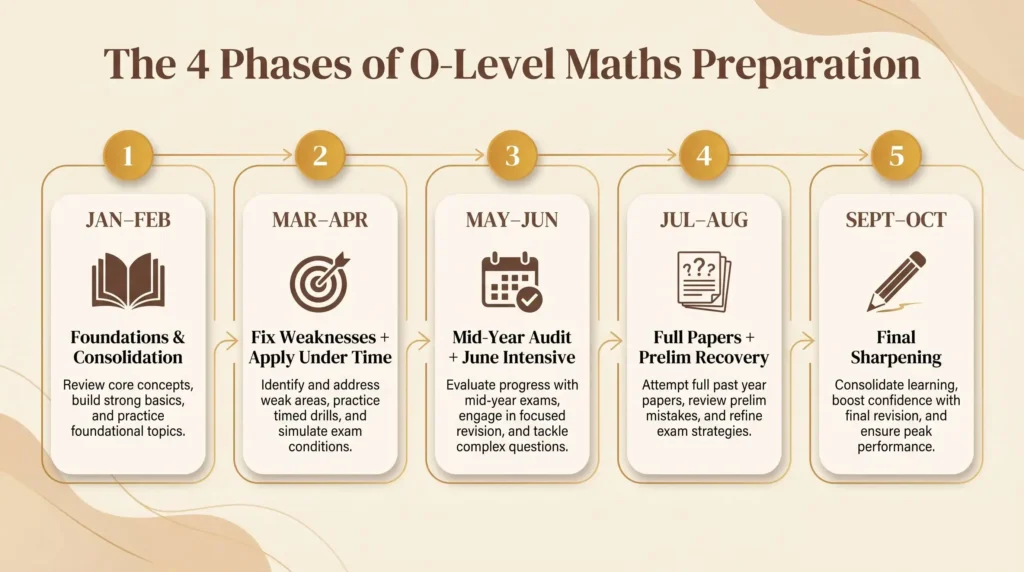
This roadmap is designed for Sec 4 students taking O-Level E Maths (4052) and, where relevant, A Maths (4049).
For A Maths, SEAB states that the syllabus is organised into three strands: Algebra, Geometry and Trigonometry, and Calculus, with both papers lasting 2 hours 15 minutes and requiring all questions to be answered. SEAB also explicitly notes that omission of essential work will result in loss of marks.
As a rough guide, students already scoring around B3 and above may need about 6 to 8 focused hours a week outside school, while students below C5 often need closer to 8 to 12 hours.
Jan–Feb: Foundations & Consolidation
Start the year by diagnosing where you are losing marks. Review your Sec 3 exam scripts, class tests, and any early Sec 4 work. Do not just note the score. Identify patterns.
Ask:
- Do I keep making algebra mistakes?
- Am I weak in trigonometry or coordinate geometry?
- Do I understand the method, or do I only recognise the question type?
These first two months should be used to stabilise the basics and keep pace with school. Every new topic taught in class should be consolidated within the same week. That means doing a small set of practice questions, updating your formula notes, and correcting errors immediately.
This is also where Andrew Yap’s progressive-learning approach fits naturally into the picture. The logic is simple: if the basics are weak in January and February, everything built on top of them becomes harder later. Strengthening the foundation early makes the rest of the year far more manageable.
Mar–Apr: Fix Weaknesses and Start Applying Under Time
By March, you should have enough test data to know which topics are holding you back. Separate your mistakes into two categories:
- Conceptual mistakes: You do not fully understand the topic
- Careless mistakes: You understand it, but lose marks through speed, presentation, or inattention
That distinction matters. Conceptual mistakes require relearning. Careless mistakes require systems: checking units, showing full working, slowing down on substitution, and verifying calculator mode.
April is when you should begin shifting from “Can I do this topic?” to “Can I do this accurately under time?”
Start introducing timed sections every week. Multi-step questions are especially important because O-Level Maths often rewards students who can link ideas across topics rather than those who can solve one-step drills.
This is also where Andrew Yap Education Centre’s emphasis on teaching becomes memorable, as it not only covers content but helps students bridge the gap between basic familiarity and real exam application. This is exactly where many students plateau if left to practise alone.
May–Jun: Mid-Year Checkpoint & Intensive Revision
Treat the mid-year period as your first serious checkpoint. It is not just another school exam. It tells you whether your current system is working.
After the paper, do a proper audit:
- Which 3-5 topics are worth the most marks?
- Were the losses caused by weak concepts, poor time use, or careless errors?
- Which question types do I still avoid?
Once that is clear, June becomes your most valuable revision window.
The goal of the June holidays is not to do random papers all day. It is to systematically close content gaps, then begin heavier paper practice. A good June plan looks like this:
- Revisit all weak topics one by one,
- Rebuild notes only for formulas or methods you keep forgetting,
- Start Ten-Year Series and selected prelim questions,
- Spend as much time reviewing errors as attempting questions.
The June holiday revision period is exactly the kind of time when students benefit from structure, accountability, and immediate correction, which is why the centre’s crash-course and intensive revision formats tend to be especially valuable.
Jul–Aug: Full Papers & Prelim Recovery
By July, revision should look increasingly like the actual exam. That means full papers, timed conditions, and honest marking.
Doing questions topic by topic is still useful, but it is no longer enough on its own. You now need to build speed, stamina, and judgement. A simple rule helps: do not let one stubborn question steal marks from easier ones later in the paper.
August is when the prelim season starts becoming real. If you do not do well for prelims, do not panic. Prelims are useful because they show exactly where the cracks still are. What matters most is what you do after them.
The best post-prelim strategy is targeted recovery:
- Identify the few topics causing the biggest mark losses,
- Redo those question types repeatedly,
- Review your error log daily,
- Keep doing papers so you do not lose rhythm.
Andrew Yap Education Centre focuses on strong post-prelim preparation, not blind mugging. It is about precise correction, strategic prioritisation, and smart use of limited time — the kind of exam maturity that experienced maths tutors are there to develop.
Sept–Oct: Final Sharpening

The final stretch is for refinement, not reinvention.
At this stage, your job is to tighten methods you already know, reinforce high-frequency question types, and reduce avoidable mark loss. Keep your revision light enough to stay fresh, but sharp enough to stay accurate.
Focus on:
- Formula recall,
- Common question structures,
- Calculator discipline,
- Complete working,
- and checking habits.
Your mistake log becomes especially useful here. Read it often. The aim is simple: do not donate marks for errors you have already made before.
Final preparation at Andrew Yap Education Centre is not about stuffing in more content for the sake of it. It is about sharpening exam habits, building confidence, and ensuring students walk into the exam feeling prepared rather than rushed.
How to Know If You Need Tuition

Not every student needs tuition. But extra support may help if:
- You keep repeating the same mistakes even after correction,
- You understand examples but freeze on unfamiliar questions,
- You run out of time in tests,
- Or your confidence is dropping despite regular effort.
If that is happening, the issue is usually not effort alone. It is that your feedback loop is too weak. You may need a clearer explanation, faster correction, or more targeted practice than a large school class can provide.
A good O-Level Maths year is rarely built on one dramatic burst of motivation. It is built month by month: solid foundations early, smart correction in the middle, and calm sharpening at the end.If you want a study plan supported by experienced maths educators, Andrew Yap Education Centre gives parents and students a recognisable expert framework to anchor this journey from January to exam day.