

O-Level Geometry often presents a significant hurdle for secondary school students in Singapore. While it forms a crucial component of the O-Level Math syllabus, its abstract nature can be particularly challenging for visual learners. At Andrew Yap Education Centre, our O-Level math tuition focuses on equipping students with effective strategies not only to understand but also to excel in this demanding subject.
This article outlines expert tuition strategies specifically designed for visual learners, ensuring they gain a deep understanding of mathematical concepts and master their O-Level exams.
Key Takeaways:
- Geometry becomes easier for visual learners when abstract theorems are consistently linked to clear diagrams and real-world shapes.
- Manipulating physical models and foldables strengthens spatial reasoning, a core skill tested in O-Level Math.
- Interactive software allows students to explore geometric properties dynamically, reinforcing a deeper understanding.
- Tutors who use step-by-step visual methods help students connect concepts, reduce misconceptions, and retain knowledge longer.
Why Geometry Challenges O-Level Students in Singapore
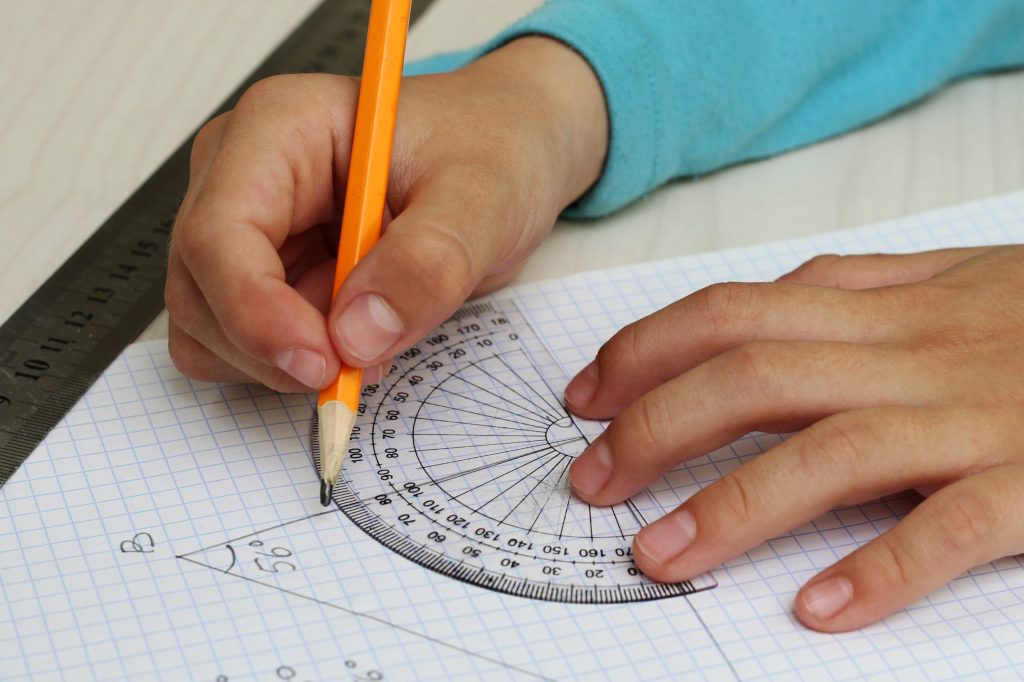
The competitive academic landscape in Singapore places immense pressure on students to perform well in O-Level Math. Geometry, with its emphasis on shapes, angles, and spatial relationships, can be a source of frustration for many students in Singapore. However, for visual learners, this subject presents a unique opportunity for mastery, provided the right tuition programme is in place.
Visual learners process information most effectively when they can “see” it, making geometry a natural fit when taught correctly. They inherently prefer diagrams, charts, and illustrations, often struggling with abstract concepts when they lack proper visual aids.
Their memory is significantly enhanced when information is presented visually, and they benefit greatly from hands-on activities and models. This learning style, well-documented in educational research, suggests that conventional teaching methods, often reliant on auditory or textual instruction, may fall short for these students.
Traditional math tuition and classroom settings may inadvertently disadvantage visual learners through:
- Over-reliance on rote memorisation of formulas: While formulas are essential, understanding their derivation and application through visual means is more effective for visual learners.
- Lack of emphasis on spatial reasoning: Geometry is fundamentally about spatial relationships, yet many programmes do not explicitly teach or develop this skill.
- Insufficient use of visual tools: From simple sketches to advanced software, a lack of diverse visual tools can hinder comprehension for visual learners.
To truly master Geometry, a tailored approach is necessary, one that acknowledges and leverages the visual learner’s strengths.
Effective Tuition Strategies for Visual Learners

Effective O-Level math tuition for visual learners is built on principles that bring abstract mathematical concepts to life.
Visualisation & Diagram Techniques
The fundamental principle is teaching students to “see” the problem. This isn’t just about looking at a diagram but actively engaging with it. Our dedicated tutors guide students in developing strong problem-solving skills by encouraging:
- Sketching and Redrawing: Students learn to sketch diagrams for every problem, adding auxiliary lines to reveal hidden relationships.
- Mental Manipulation: Training to mentally rotate, flip, or unfold shapes to understand their properties.
- Example: When tackling a complex 3D math problem, drawing its 2D projections from different angles helps students break down the problem and grasp its intricacies. A study on spatial visualisation highlighted that students who actively draw and manipulate diagrams during geometry problem-solving demonstrate superior understanding and retention.
Hands-on & Manipulative Learning
Hands-on learning is invaluable for secondary school math tuition. It transforms abstract theorems into tangible experiences, fostering a deep understanding of key topics.
- Physical Models: Using tools like geoboards, 3D geometric solids, tangrams, and paper cutouts allows students to physically manipulate shapes and understand concepts such as congruence, similarity, and volume.
- Foldables: Creating interactive foldables for theorems helps students organise information visually and spatially.
These methods enhance spatial reasoning and provide a concrete foundation for understanding complex mathematical concepts, ensuring that students can excel beyond mere memorisation.
Using Technology as a Visual Aid
In today’s digital age, technology offers dynamic visual aids that static diagrams cannot.
- Geometry Software: Tools like GeoGebra allow students to construct, measure, and transform geometric figures interactively. This is particularly useful for exploring properties of circles, transformations, and advanced trigonometry.
- Interactive Simulations: Online simulations can demonstrate complex concepts, such as how varying angles affect side lengths in a triangle or the properties of different types of equation graphs.
The Singapore Ministry of Education (MOE) has increasingly advocated for the integration of technology in mathematics education to foster deeper conceptual understanding. Hence, our math tuition centre in Singapore embraces these tools to create an engaging learning environment.
Proven Methods Tutors Use to Build Confidence
At Andrew Yap Education Centre, our experienced tutors employ specific strategies to help students excel in their O-Level exams.
Simplifying Complex Problems
Many math problems in O-Level Math involve complex diagrams. Our strategy teaches students to:
- Redraw and Simplify: Recreate diagrams to remove clutter, highlighting only the relevant information.
- Add Auxiliary Lines: Guide students to strategically add lines that reveal new relationships or create familiar shapes (e.g., perpendiculars, parallel lines).
- Label Precisely: Ensure all given information and unknown quantities are clearly labelled on the diagram.
This systematic approach helps visual learners break down complex problems and formulate a clear plan to approach and solve complex questions.
Visual Revision Tools & Mind Maps
For visual learners, connecting concepts is easier when seen.
- Visual Concept Webs: Creating mind maps that link various mathematical concepts – for instance, connecting properties of different quadrilaterals, circle theorems, and trigonometry identities.
- “Cheat Sheets” with Diagrams: Encouraging students to create their own visually-rich revision notes for key topics and formulas.
This method helps students build a strong foundation and see the interconnectedness of the O-Level math syllabus.
To ensure a deep understanding, our tutors help students by presenting solutions with accompanying diagrams at each significant step. Students can visually track the progression of the solution, making it easier to identify where they went wrong in their own attempts.
“See-It-To-Believe-It” Proofs
Instead of rote memorisation, our tuition programme focuses on demonstrating why a theorem is true. For example:
- Area Proofs: Visually demonstrating that the area of a triangle is half the base times height by cutting and rearranging a rectangle or parallelogram.
- Pythagorean Theorem: Using a dissection proof where squares built on the sides of a right-angled triangle are rearranged to show the relationship between their areas.
This method creates a deeper, more intuitive understanding of mathematical concepts, moving beyond just knowing the formula to truly understanding its basis.
How Can Andrew Yap Education Centre Tuition Help Learners Master O-Level Math?
The Andrew Yap Education Centre offers comprehensive math tuition in Singapore designed to help students excel in their O-Level exams. Our math tuition is personalised and tailored to your level, ensuring every student receives the attention they need.
Our tuition centre in Singapore stands out with:
| Feature | Description | Benefit for Visual Learners |
| Experienced Tutors | Lessons are conducted by highly qualified tutors with experience in MOE teaching, NIE training, and proven classroom results. | Clear explanations that simplify abstract math concepts. |
| Small Class Sizes | Classes are intentionally kept small to ensure every student receives personal guidance and feedback. | Close monitoring and targeted feedback to strengthen understanding. |
| Engaging Teaching Methods | Tutors use step-by-step reasoning, teaching aids, and real exam examples to explain complex topics. | Builds strong problem-solving skills through step-by-step reasoning. |
| Targeted Practice | Exam-style worksheets and structured drills cover key O-Level E Maths topics systematically. | Reinforces learning and prepares students for typical math question types. |
| Comprehensive Notes | Notes packed with key formulas and worked examples. TYS books written by Andrew & Jasmin Yap (owners of the tuition) are also utilised as effective references. | Provides clear summaries for effective revision. |
Our tutors provide guidance and support not just for the exams but also for developing lifelong problem-solving skills. We equip students with the knowledge and the confidence to excel in their O-Level exams.
Turning Visual Strengths into Exam Confidence
For visual learners in Singapore, mastering O-Level Geometry is not about inherent talent but about the right tuition strategies. By embracing visualisation, hands-on learning, and leveraging technology, students can transform challenging math problems into opportunities for deep understanding.
At Andrew Yap Education Centre, our structured O-Level math tuition is committed to helping students achieve academic success, equipping them with effective problem-solving skills and boosting their confidence.
Explore how our tailored approach to math tuition in Singapore can guide your child to excel in their O-Level exam. Contact us today.
Frequently Asked Questions about O-Level Geometry Tuition
What are the main challenges to learning O-Level Geometry for visual learners?
Visual learners often face challenges when geometry is taught abstractly, without sufficient diagrams, real-world examples, or opportunities for hands-on manipulation. They may struggle to conceptualise 3D shapes from 2D drawings or grasp trigonometry without visual context. For instance, Paper 2 of the O-Level E Maths examination frequently includes complex geometrical problems that require strong visualisation skills.
How does tuition help students gain a deeper understanding of mathematical concepts in Geometry?
Our math tuition provides a structured and visual approach. Dedicated tutors break down complex theorems into manageable steps using diagrams, manipulatives, and interactive software. This method helps students build a strong foundation and develop critical thinking skills, allowing them to approach and solve complex math problems effectively. Students gain clarity through personalised explanations and visual demonstrations, allowing them to connect new information with existing knowledge.
Is E-Math tuition necessary for O-Level Geometry if my child is a visual learner?
While self-study is possible, E-Math tuition is personalised and often invaluable for visual learners. A good math tutor can identify specific learning gaps, introduce effective visual strategies, and provide the one-on-one guidance and support needed to master challenging topics. This ensures many students are well-prepared for their next O-Level E Maths exam. Our centre in Singapore focuses on helping students achieve their academic goals.
What key topics in the O-Level Maths syllabus are most effectively taught visually?
Nearly all geometry topics benefit from visual teaching. This includes:
- Angles and Parallel Lines: Demonstrating relationships with diagrams and physical models.
- Polygons and Circles: Exploring properties through constructions and interactive software.
- Trigonometry: Visualising sine, cosine, and tangent as ratios within right-angled triangles.
- Mensuration (Area and Volume): Using 3D models and cut-outs to understand formulas.
- Transformations: Graphing and manipulating shapes on a coordinate plane.
Our tuition programme provides comprehensive coverage of key topics in the O-Level E Maths syllabus.