

Do complex equations feel like an insurmountable mountain in your A-Math journey? You are not alone. Additional Mathematics (A-Math) is an elective subject in Singapore’s secondary school curriculum that builds on the foundations of Elementary Mathematics (E-Math). It is widely regarded as one of the most challenging subjects in Singapore, with its heavy emphasis on algebra, geometry, trigonometry, and calculus. Strong performance in A-Math not only boosts confidence in handling advanced mathematical concepts but also opens doors for students aiming to pursue Mathematics in junior college or university.
This comprehensive guide will equip you with strategies through tuition and a crash course to navigate the intricacies of A-Math problems, transforming confusion into clarity and ultimately helping you excel in your math exam.
Key Takeaways:
- Systematic error-checking helps eliminate common algebra mistakes, such as sign slips and misapplied formulas.
- Focusing on high-frequency topics from past SEAB papers maximises exam readiness.
- Combining tuition for the foundation with crash courses for exam speed ensures balanced mastery.
- Active recall and error analysis strengthen long-term retention and problem-solving flexibility.
Understanding the Algebra involved in A-Math

Problem-solving involved in A-Math is more than just manipulating symbols; it is a critical component of the Secondary (Sec) math syllabus in Singapore, demanding both conceptual understanding and precise application. To truly ace it, one must first identify its core elements and common pitfalls.
Key A-Math Algebra Topics
The MOE syllabus for A-Math encompasses several crucial algebraic topics. Mastering these is non-negotiable for students in Singapore aiming for top grades.
- Quadratic Equations & Inequalities: Understanding the discriminant, roots, and various methods for solving quadratic equations and inequalities.
- Surds & Indices: Simplifying expressions involving irrational numbers and powers.
- Polynomials & Partial Fractions: Manipulating polynomials through division and expressing rational functions as sums of simpler fractions.
- Binomial Theorem: Expanding expressions of the form (a+b)ⁿ for positive integer n.
- Logarithms & Exponentials: Solving equations and seeing how graphs of exponential functions are used in real-life contexts.
- Functions & Graphs: Analysing graph characteristics and transformations, particularly for algebraic functions.
Common Pitfalls & Misconceptions
Many students in Singapore struggle not because of a lack of intelligence, but due to specific recurring issues:
- Careless Algebraic Manipulation: Errors such as sign mistakes or improper expansion remain widespread; hands-on tools like algebra tiles have significantly helped reduce these “slips.”
- Misconception of the Equals Sign & Conceptual Gaps: Viewing “=” as leading to an answer rather than indicating equivalence reflects deeper misunderstandings; addressing this improves flexibility in algebra.
- Time Management Issues: Rushing through questions, especially under exam pressure, leads to avoidable errors even among capable students.
- Difficulty Translating Word Problems: Translating from text to algebraic expressions is challenging; structured strategies, such as the “Read–Plan–Solve–Check” approach, can improve performance.
- Surface Learning & Formula Reliance: Without understanding the “why” behind formulas, students struggle to apply them to new problems; visual models (e.g., bar models or diagrams) improve conceptual understanding.
The Power of A-Math Tuition

A-Math tuition has long been a cornerstone of academic success for students in Singapore, and for good reason. It offers a structured and personalised approach to excel in topics like differentiation and integration.
Why Traditional Tuition Works
Effective math tuition provides distinct advantages that classroom settings often cannot replicate:
- Personalised Learning: A dedicated math tutor can identify specific areas of weakness for each student and tailor instruction accordingly.
- Expert Guidance: Tuition centres like Andrew Yap Education Centre boast tutors with years of teaching experience who possess deep subject knowledge and a profound understanding of the MOE syllabus and exam papers.
- Structured Curriculum: High-quality math tuition Singapore programmes follow a systematic progression, ensuring all essential topics are covered comprehensively and constantly aligned with the latest syllabus and exam trends.
- Instant Feedback: Doubts can be clarified immediately, preventing misunderstandings from festering. This direct interaction is invaluable for building problem-solving skills.
What to Look for in an A-Math Tuition Centre/Tutor?
When choosing the right tuition in Singapore, focus on quality and a tailored approach to ensure the best outcome for your math journey.
- Proven Track Record: Look for tuition centres with demonstrable success stories and positive testimonials from past students. This indicates their ability to help students achieve top grades.
- Experienced & Engaging Tutors: An effective tutor not only understands complex concepts but can also simplify them. Their teaching skills should make the material approachable and engaging.
- Small to Medium Class Sizes: Small to Medium class sizes allow for more individualised attention, making it easier for tutors to address each student’s needs.
- Focus on Conceptual Understanding & Application: The goal is not just rote memorisation of formulas but a deep understanding of math concepts and how to apply them to varied question types in a real exam setting.
Maximising Your Tuition Experience
To truly ace your A-Math with tuition, here are things you have to do as a student:
- Active Participation: Ask questions, engage in discussions, and don’t hesitate to seek clarification when needed.
- Consistent Practice: The learning doesn’t stop after the tuition session. Dedicate time to practice the concepts learned.
- Regular Review: Revisit math ideas and solutions from previous sessions to solidify your understanding.
A-Math Crash Course: The Turbocharge for Exam Readiness
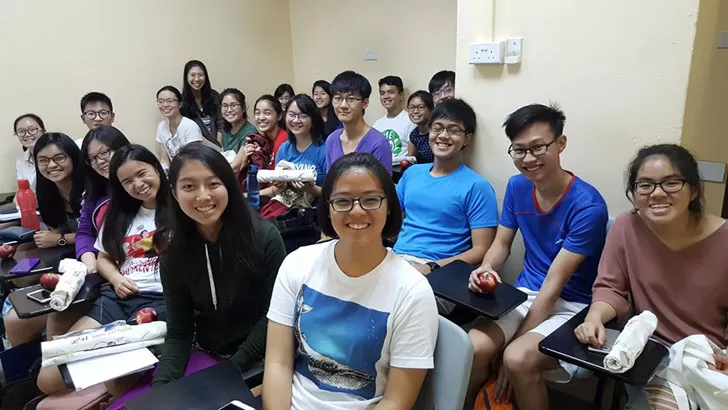
While tuition builds a strong foundation, an A-Math crash course acts as an intense, focused burst of revision, ideal for the final sprint towards the math exam.
When a Crash Course is Ideal
A crash course is specifically designed for:
- Last-Minute Revision: Consolidating knowledge in the weeks leading up to the O-Level Math exam.
- Targeting Specific Weak Areas: Rapidly addressing identified weak spots in algebra, trigonometry, or vector, for instance.
- Consolidating Knowledge: Providing a holistic review of the MOE syllabus, ensuring no important topics are overlooked.
- Boosting Confidence: Intensive practice under timed conditions can significantly build confidence for the real exam.
Key Features of an Effective A-Math Crash Course
A practical A-Math crash course is characterised by its intensive review and strategic exam techniques.
- High-Intensity Revision: The course will cover key topics in a concise yet thorough manner, focusing on essential topics frequently tested in exam papers.
- Focus on Exam-Oriented Questions: Extensive practice with past exam papers and common question types prepares students for the format and demands of the O-Level math exam.
- Time-Saving Techniques & Shortcuts: Tutors will guide students through efficient problem-solving skills and strategies to manage time effectively during the exam.
- Drill & Practice Sessions: Reinforcement of learning through hands-on application, often involving worksheets and timed exercises.
- Systematic Strategies for Complex Equations: Tutors demonstrate step-by-step methods, breaking down problems, visualising concepts with graphs, and clarifying underlying principles so students can apply knowledge flexibly in exams.
- Mental Toughness & Strategy: Beyond just academics, a good crash course also prepares students for the psychological demands of the exam, helping them develop confidence and skills.
Choosing the Right Crash Course
When selecting a crash course in Singapore, look for the following qualifications:
- Reputation and Reviews: Look for centres with a strong reputation for producing results, with proven success in preparing Secondary 4 students for O-Level exams.
- Course Content Alignment: Ensure the course content is aligned with the latest MOE syllabus for A-Math.
- Instructor’s Expertise: The tutor leading the crash course should have substantial experience specifically with O-Level Math and A-Math.
- Duration and Schedule Suitability: Select a course that aligns with your existing study schedule and allows sufficient time for both instruction and practice.
Combining A-Math Tuition and Crash Courses
The most effective approach for students in Singapore aiming to excel in exams often involves a strategic combination of both regular math tuition and an intensive crash course.
Tuition for Foundation, Crash Course for Refinement
Think of tuition as building a robust house (your fundamental understanding of math concepts), and the crash course as furnishing and polishing it for display (refining your problem-solving skills and exam readiness).
Sample Study Plan:
Integrating both effectively throughout the academic year can look something like this:
- Terms 1-3: Consistent weekly math tuition sessions to build a strong foundation in all A-Math topics, addressing weak spots as they arise.
- Pre-Exam Period (1-2 months out): Enrol in a targeted A-Math crash course. This intensive period is for high-volume revision, tackling challenging exam questions, and perfecting problem-solving skills under timed conditions.
Effective Learning Techniques in a Crash Course
- Active Recall with Guidance: Instead of memorising passively, tutors will test you with rapid-fire questions and explain step-by-step solutions to topics like the binomial theorem or vectors by partial fractions.
- Spaced Repetition: Key concepts are revisited systematically across sessions to boost retention and understanding.
- Error Analysis in Class: Mistakes are reviewed immediately, with teachers clarifying whether the issue was conceptual, algebraic, or a misinterpretation, saving students time and confusion.
- Diverse Resources: Beyond textbooks, crash courses integrate curated worksheets, past exam questions, and topical drills that align with current O-Levels trends.
- Problem-Solving Drills: Students practise both straightforward and multi-step questions under supervision, ensuring they can tackle everything from basic equations to real-life scenario problems.
- Structured Problem-Solving Flow: Students are taught to solve problems in clear steps: read carefully, identify relevant concepts, plan, calculate, and check answers, while reinforcing accuracy with sign checks and proper rounding.
Utilising Past Year Papers
One of the most powerful elements of crash courses is guided practice with past year O-Level papers. Instead of tackling them alone, students benefit from:
- Pattern Recognition: Familiarise yourself with the structure, marking scheme, and distribution of question types.
- Simulated Exams: Simulate the real exam environment to improve time management and build confidence.
- Targeted Focus: Pinpoint essential topics and question styles that frequently appear.
Ace A-Math Algebra with the Right Tuition and Crash Course
Mastering A-Math to excel in your exams is an achievable goal for every student in Singapore. It requires a multi-faceted approach, strategically combining the personalised guidance of math tuition, the intensive focus of a crash course, and diligent self-practice.
By building a strong foundation with quality A math tuition, turbocharging your revision with an A-Math crash course, and consistently honing your problem-solving skills through self-study, you can navigate even the most complex concepts with confidence. Let us help you take control of your math journey. Contact Andrew Yap Education Centre Tuition today.