

Should your child take G3 Additional Mathematics? It is a sound choice for students aiming at Junior College science streams or engineering polytechnic courses, and only if they have strong algebra, a clear pathway and a plan for support. Use the readiness gates below to decide.
Full Subject-Based Banding (Full SBB) replaced the old Express and Normal (Academic) labels with G1, G2 and G3 levels. Many parents find the change confusing, so this guide explains what it means for upper secondary maths.
In this guide:
- What G3 A-Math is and how it differs from G2
- A readiness checklist and early warning signs
- The hardest topics, a month-by-month plan and how it affects JC and polytechnic options
What Is G3 Additional Mathematics in Singapore?
Under Full Subject-Based Banding (Full SBB), secondary school subjects are offered at three levels: G1, G2 and G3. G3 is the most rigorous level and is equivalent to the former Express stream standard. It suits students with a strong aptitude for maths who are likely to pursue university pathways that need deep analytical skills.
Additional Mathematics (A-Math) is an elective taken in Secondary 3 and 4. It is not compulsory, unlike Elementary Mathematics (E-Math). A-Math builds the foundation for higher studies in science, engineering and technology.
The syllabus codes are:
- Syllabus 4049: G3 Additional Mathematics, the standard O-Level syllabus.
- Syllabus 4051: G2 Additional Mathematics, formerly the N(A) Level syllabus.
G3 A-Math bridges school mathematics and the advanced mathematics of H2 Math or polytechnic engineering diplomas. Students must prove, derive and model complex situations.
G3 vs G2 Additional Math — What’s the Actual Difference?
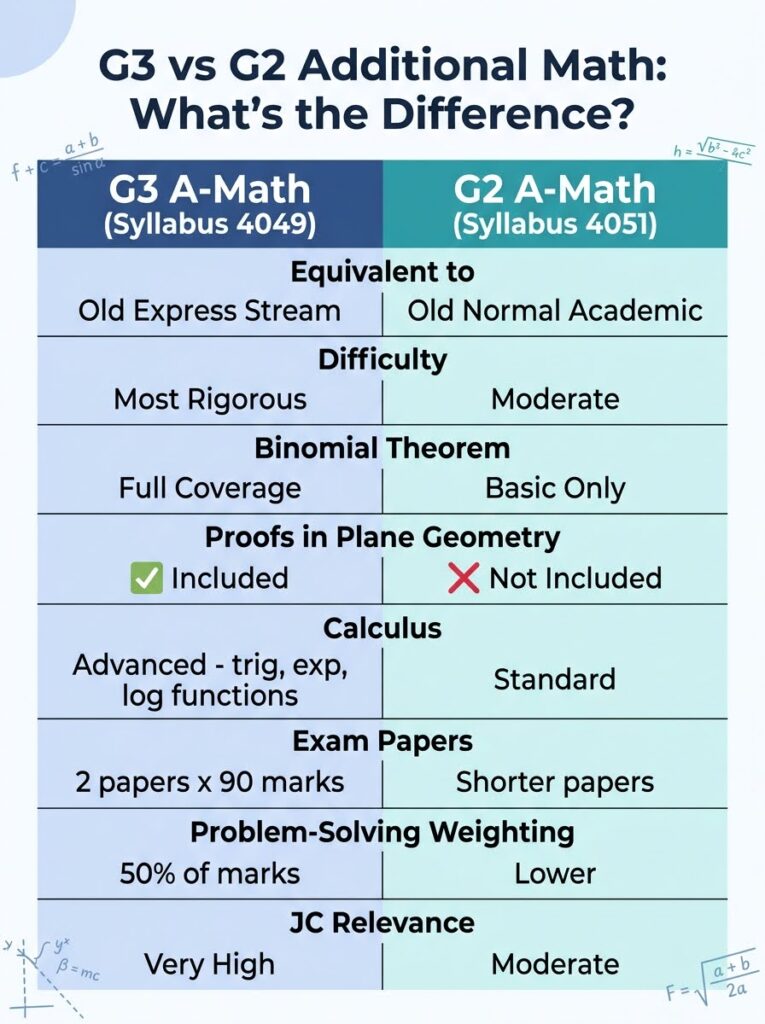
Both levels cover algebra and calculus, but G3 is considerably more demanding. The table below sets out the key differences.
| Feature | G3 A-Math (Syllabus 4049) | G2 A-Math (Syllabus 4051) |
| Difficulty level | High (most rigorous) | Moderate |
| Equivalent to | Old Express stream | Old Normal (Academic) stream |
| Binomial theorem | Full coverage, including general terms and proofs | Basic coverage only |
| Calculus depth | Advanced (trigonometric, exponential and logarithmic functions) | Standard (polynomials only) |
| Proofs in plane geometry | Included (required) | Not included |
| Paper length and format | Two papers, each 2h 15m and worth 90 marks | Shorter duration, fewer marks |
| Problem-solving weighting (AO2) | Higher | Lower (more routine skills) |
| JC eligibility | Directly prepares for H2 Math | Bridging course often required for H2 Math |
Key takeaway: G3 is not simply “more maths”. It includes whole topics, such as geometry proofs, that G2 does not. Students switching from G2 to G3 often struggle without significant bridging support.
Should Your Child Take G3 Additional Math? (Parents’ Readiness Checklist)
Being able to take G3 A-Math does not always mean your child should. It is demanding and needs consistency and resilience. Work through this checklist together with your child.
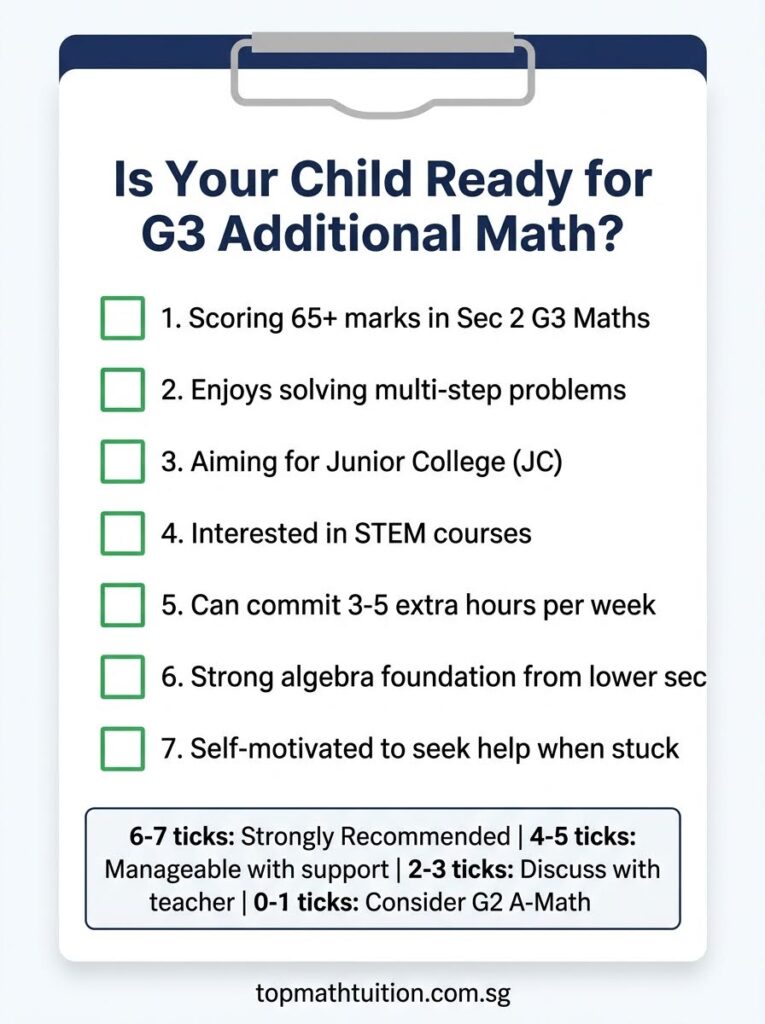
Work through four gates in order. Failing a gate points to a specific action.
- Algebra gate: Can your child handle quadratics, inequalities and surds fluently, without a calculator? If not, strengthen algebra for a term first.
- Pathway gate: Does your child’s target JC science stream or polytechnic course require A-Math? If undecided, keep G2 open or consult the school.
- Workload gate: Does your child have roughly 4 to 6 hours a week for self-study and practice? Rule of thumb only: confirm the expected time with the school.
- Support gate: Is there a plan if your child falls behind, such as teacher consultation, a study group or tuition?
Schools publish their own guidance on the Secondary 2 Mathematics results needed to take G3 A-Math, so check it before relying on any single threshold. If your child is below it, speak to the school about the G2 option.
Self-assessment table:
| Indicator | Strong signal | Warning sign |
| Algebra fluency | Solves equations and rearranges formulas without prompting | Frequent sign errors or calculator reliance for simple surds |
| Independent work | Attempts unfamiliar questions before asking for help | Stops at the first difficulty |
| Reasoning | Explains why a method works | Memorises steps without the logic |
| Time management | Finishes practice sets in expected time | Runs out of time on familiar topics |
Signs Your Child Is Struggling Early
Watch for consistent patterns, not a single bad test. Warning signs include avoiding algebra homework, repeating corrected mistakes, and needing a parent or tutor to explain every step. Careless errors and a missing method need different fixes, so review where marks were lost.
A strong E-Math result is a good sign but not proof of A-Math readiness. E-Math rewards accurate procedures, while A-Math asks students to build and justify arguments. If quadratic inequalities feel unfamiliar, strengthen algebra before enrolling.
G3 Additional Math Syllabus: What Will Your Child Actually Learn?
The G3 A-Math syllabus is split over two years, so the workload peaks in Secondary 4.
Secondary 3 Topics (Building the Foundation)
Algebra dominates the first year. Weak algebra will make Secondary 3 difficult.
- Quadratic functions: Discriminants, maximum and minimum points, and sketching curves.
- Equations and inequalities: Complex inequalities and non-linear simultaneous equations.
- Surds: Working with irrational numbers such as √2 without a calculator.
- Polynomials and partial fractions: Long division and simplifying complex fractions.
- Binomial expansions: Expanding high powers, such as (x + y)¹⁰, using formulas.
- Exponential and logarithmic functions: The language of growth and decay, crucial for science subjects.
Secondary 4 Topics (Advanced Concepts)
The second year introduces calculus and advanced geometry, which are often conceptually harder.
- Trigonometric functions, identities and equations: Much deeper than Secondary 2, including proving identities such as sin²x + cos²x = 1.
- Coordinate geometry: Analysing circles, straight lines and quadrilaterals on a graph.
- Proofs in plane geometry (G3 only): Strict logical proofs about circles, tangents and chords.
- Differentiation: Rates of change, gradients of curves and optimisation problems.
- Integration: The reverse of differentiation, used to find areas under curves.
The 4 Hardest Topics in G3 A-Math (And What Parents Should Watch For)
Four topics trip up students every year. Knowing them in advance helps you track your child’s progress.
1. Differentiation and Integration (Calculus)
The basic rules are learnable, but application questions, such as kinematics and rates of change, require translating word problems into mathematical models. Many students struggle not because they cannot integrate, but because they misread what the question asks.
2. Proofs in Plane Geometry
Unique to G3, this topic is purely logical. Students must derive a proof from geometric properties, justifying each step with a theorem. Students who only learned informal geometry often stumble here.
3. Binomial Theorem
This is often the first wall students hit in Secondary 3, usually around April or May. Factorials (!) and combinations (nCr) look like a foreign language to beginners, and confidence often takes a hit before the mid-year exams.
4. Trigonometric Identities
Unlike lower secondary trigonometry, this topic involves memorising extensive lists of formulas, such as double-angle and addition formulas. The challenge is knowing which formula to apply.
How G3 Additional Math Affects Your Child’s Post-Secondary Options
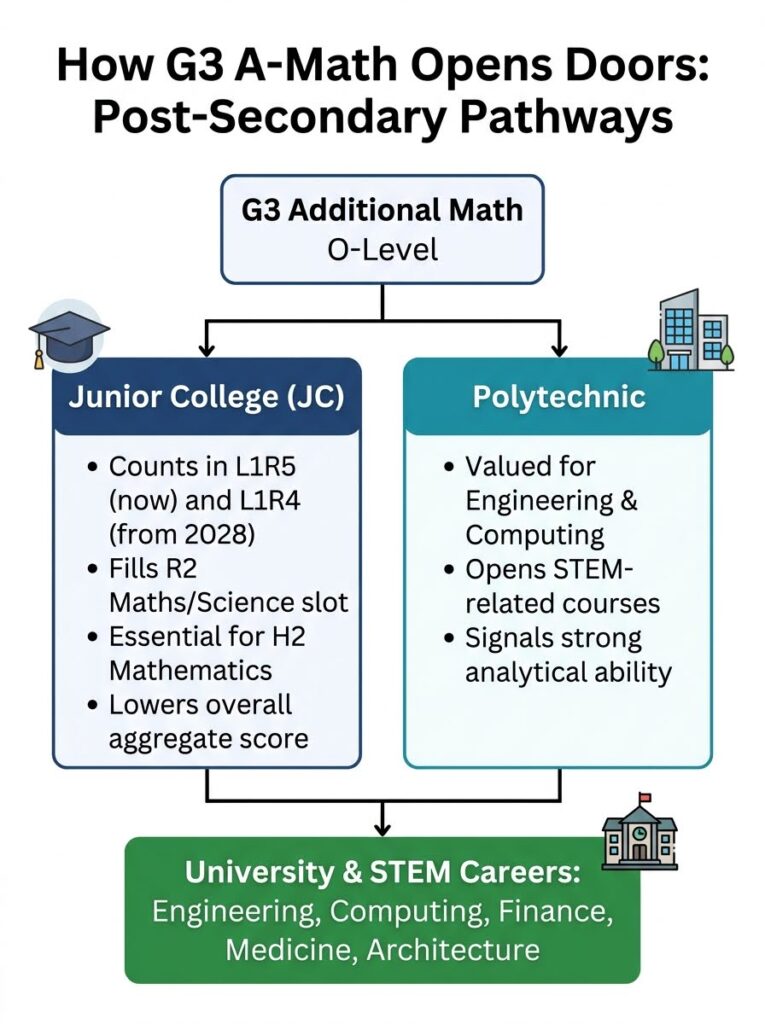
Your child’s subject combination directly influences their admission score for Junior College (JC) or polytechnic.
JC Admission: L1R5 vs. L1R4
JCs currently use the L1R5 scoring system, which counts First Language plus five Relevant Subjects. The scoring basis is set to move to L1R4 from 2028, so check the current MOE JC admissions page for the latest rules.
- A-Math is a “Relevant” subject: In both systems, it counts in the Math and Science category.
- Double maths advantage: Students taking both E-Math and A-Math have two chances to score well in that category, and the system picks the best result.
- Prerequisite for H2 Math: Additional Mathematics is not a compulsory JC entry requirement, but it is strongly recommended for students who want to take H2 Mathematics, a prerequisite for engineering, data science, economics and science degrees. Requirements vary, so check each JC’s published criteria.
Polytechnic Pathways
A-Math is a key subject for the Relevant 2 component in courses such as:
- Engineering (aerospace, civil, mechanical and others)
- Information technology and cybersecurity
- Life sciences and chemical engineering
Even where it is not strictly compulsory, students without A-Math often struggle in first-year maths modules, which assume that knowledge.
Is A-Math Necessary for Non-Science Pathways?
Not always. A-Math matters most for JC science streams, H2 Mathematics and engineering polytechnic courses. For arts, humanities or business pathways, E-Math may suffice, though some economics or finance degrees still expect strong quantitative skills. Check the entry requirements of the courses your child is considering.
Month-by-Month Action Plan for Sec 3 G3 A-Math (For Parents)
Use this timeline to keep your child on track through the critical Secondary 3 year.
| Month | Topic focus or milestone | Parent action |
| January | Quadratic functions and inequalities | Ensure homework is submitted on time. Watch for confusion about discriminants. |
| February | Surds and indices | Check they show working rather than relying on the calculator. |
| March | Polynomials | First checkpoint: if results fall below your school’s guidance or your child’s usual level, seek help promptly. |
| April | Binomial theorem | High-risk topic. Ensure they understand the general term formula. |
| May | Mid-year exams | Review where marks were lost: carelessness or lack of understanding. |
| June | Holidays and catch-up | If mid-year results were poor, use June for focused revision or a short intensive course. |
| July | Logarithms and modulus functions | Encourage practice of standard textbook questions until fluent. |
| August | Trigonometric functions | Memorising the graphs of sin, cos and tan is key. |
| September | Coordinate geometry | Check their understanding of circle questions. |
| October | End-of-year exam revision | Start full timed practice papers, not just topical drills. |
| November | Final exams | Celebrate the effort regardless of result. Analyse the paper to plan for Secondary 4. |
5 Ways Parents Can Support Their Child in G3 A-Math (Without Being a Math Expert)
- Ask “How did you get that?” rather than “Is that right?” This shows whether your child understands the method, not just the answer.
- Set a regular study rhythm. Short, consistent sessions work better than occasional long revisions.
- Monitor test scores over time. Look for patterns across the year rather than reacting to a single score.
- Encourage independent attempts. Let your child try a problem for a fixed time before asking for help.
- Consider specialist tuition early. If a gap persists, specialist tuition may help address it before it grows. Early support is usually easier than catching up in Secondary 4.
What to Look for in a G3 Additional Math Tutor in Singapore
A good tutor explains the reasoning behind methods and diagnoses why a student makes mistakes. Ask how they track progress, how they teach geometry proofs, and whether class sizes allow individual attention. You can get in touch with us to discuss your child’s readiness.
Frequently Asked Questions About G3 Additional Math
Can my child switch from G2 to G3 A-Math after starting Sec 3?
Switching mid-course is possible in some cases but harder than it looks. G3 covers topics, such as geometry proofs, that G2 does not, so a switching student must catch up on them. Talk to the school and consider a bridging plan first.
Is G3 A-Math compulsory?
No. G3 A-Math is an elective. E-Math is the compulsory mathematics subject.
What score in Sec 2 G3 Math is needed to take G3 A-Math?
Requirements vary by school. Check your child’s school for its published guidance.
Does G3 A-Math appear on the O-Level certificate?
Yes. A-Math results appear on the O-Level certificate and count towards JC and polytechnic admission.
Is G3 A-Math harder than H2 Maths at JC?
They are different. G3 A-Math is a secondary-level subject with a wide range of topics and a strong emphasis on reasoning. H2 Math goes deeper into specific areas and is typically taken at JC. G3 A-Math is widely regarded as preparation for H2 Math rather than a replacement for it.
How many hours per week should my child study G3 A-Math?
Plan for roughly 4 to 6 hours of A-Math study per week. This is a guide. Students still building algebra fluency may need more, and confident students may need less.
What is the pass rate for G3 A-Math at O-Levels?
Pass rates are published by the Singapore Examinations and Assessment Board (SEAB) in its official results releases. Check the latest figures directly, as they change from year to year.
What if my child is struggling halfway through the year?
Act early. Speak to the subject teacher, review recent test papers to identify specific gaps, and consider short-term focused support. Waiting until end-of-year exams usually makes recovery harder.
Conclusion
G3 Additional Mathematics opens the door to JC science streams and engineering courses, but it suits students with a secure algebra foundation and a clear pathway that requires it. Choosing it for prestige alone tends to create more strain than benefit. Work through the readiness gates and seek support early if a gap appears. Contact Andrew Yap Education Centre today or visit us at Block 302, #01-1842, Ang Mo Kio Ave 3, Singapore 560302 if you would like help deciding.