

If you are a JC student or parent, the revised University Admission Score (UAS) system demands your attention. From academic year 2026 (AY2026), local university admissions shift from a 90-point scale to a leaner 70-point framework, fundamentally altering how much weight each subject carries.
For many students, investing in quality JC Math Tuition has become a strategic decision rather than a last resort. Under this new system, H2 Mathematics is no longer just another subject. It is one of the most consequential components of your university application, particularly if you are targeting competitive courses at NUS, NTU, or SMU.
Key Takeaways:
- Singapore’s revised 70-point UAS system from AY2026 means every H2 subject now carries significantly more weight in university admissions.
- A strong H2 Maths grade can directly improve admission chances for competitive courses such as Medicine, Dentistry, Law, Computer Science, and various Data Science-related fields.
- Under the new scoring framework, a single grade drop in H2 Maths can have a greater impact on overall UAS than under the previous 90-point system.
- Many JC students struggle with H2 Maths because of the sharp jump in difficulty from O-Level Additional Mathematics and the greater emphasis on higher-order problem-solving.
- Structured JC Math Tuition can help students strengthen weak areas early, improve exam techniques, and maximise their university admission opportunities under the revised UAS framework.
What Is Singapore’s New 70-Point UAS System?
Education Minister Chan Chun Sing announced changes to the A-Level scoring framework in March 2023.
Here is how the new calculation works:
| Component | Maximum Points |
| H2 Subject 1 | 20 |
| H2 Subject 2 | 20 |
| H2 Subject 3 | 20 |
| H1 General Paper | 10 |
| Total | 70 |
The fourth content-based subject and H1 Mother Tongue are now only included if they improve your score. Project Work has become Pass/Fail and no longer contributes to your UAS.
Under the old system, six components contributed mandatorily to your score, allowing weaker subjects to be partially offset. Under the new framework, the 4th content subject and H1 Mother Tongue only contribute if they improve your UAS — significantly reducing that cushion. With your three H2 subjects alone accounting for ~86% (60/70) of your UAS and H1 General Paper making up the remaining 14%, every grade now carries considerably more influence.
Why H2 Maths Now Carries More Weight in University Admissions
Fewer scored components mean each grade hits harder. A single H2 subject accounted for 22.2% of your UAS (20/90). It now counts for 28.6% (20/70) — and H2 Maths sits at the centre of that shift for any quantitative course.
Here’s how the prerequisite landscape looks across the three local universities:
- NUS Computer Science: H2 Maths required; bridging course needed otherwise
- NTU Mechanical Engineering: Requires H2 Maths+ H2 Physics, Chemistry, Biology, or Computing
- NTU Computer Engineering: Requires H2 Math + H2 Physics, Chemistry, Biology, or Computing
- SMU Economics: A good pass in H2 Mathematics, H2 Further Mathematics, or O-Level Additional Mathematics required
Even where H2 Maths isn’t strictly required, SMU Economics being the obvious example, a strong grade has become a competitive differentiator. Admissions committees read it as quantitative readiness, plain and simple.
The Real Impact of One Grade Drop in H2 Maths
Under the 70-point system, the margin for error has narrowed. A single grade drop from A to B in H2 Maths costs you 2.5 points (from 20 to 17.5), roughly 3.6% of your entire score.
The numbers from this year’s published Indicative Grade Profiles (IGPs) make the stakes concrete. NTU Computer Science ranges from AAB/C at the 10th percentile to AAA/A at the 90th. NUS Business Administration runs from AAA/C to AAA/A. At the upper end of these bands, the gap between admission and rejection is often a single grade in a single H2 subject.
You can no longer count on a strong H1 or fourth subject to “balance out” a weaker H2 grade. Each of your three H2 subjects has to perform on its own merits.
Why Many JC Students Struggle With H2 Maths

The transition from O-Level Additional Mathematics to H2 Mathematics is one of the steepest academic jumps in Singapore’s education system. The Vectors topic in H2 Maths is significantly more extensive than its 2D counterpart in O-Level Additional Mathematics, extending into 3D geometry, lines, planes, and spatial reasoning not covered at O-Level.
Students commonly report these topics as most challenging:
- Vectors: Requires 3D spatial visualisation and geometric reasoning
- Integration: Demands mastery of multiple techniques and recognition of which applies
- Permutations and Combinations: Logic-intensive, where a single miscount unravels solutions
- Complex Numbers: Abstract concepts with limited real-world intuition
- Differential Equations: Combines integration techniques with modelling skills
Mr Andrew Yap, who holds a Master’s degree in Mathematics from NUS and received the Lijen Industrial Development Medal for best thesis, notes that struggling students often lack structured guidance addressing specific gaps before those gaps compound.
How Targeted JC Math Tuition Can Improve UAS Outcomes

H2 Maths papers test whether you can identify which techniques to apply, execute them accurately, and manage time across challenging papers. This is where targeted JC Math Tuition becomes valuable.
Structured tuition helps students through:
- Early gap identification: Discovering weaknesses before promotional exams rather than during them
- Improved answering precision: Learning exactly what examiners expect from marking schemes
- Speed and confidence: Timed practice reduces anxiety and builds efficiency
- Higher-order question exposure: Guided practice with integrative questions combining multiple topics
The investment should be viewed in light of the stakes. Under the new 70-point UAS, a single grade improvement in H2 Maths can meaningfully shift your admissions position.
What Students Should Look for in JC Math Tuition
When evaluating H2 Maths support, consider these factors:
- Deep familiarity with SEAB examination requirements, including common question patterns and marking conventions
- Specialisation in H2 Mathematics rather than broad coverage across many subjects
- Small class sizes allow personalised attention to individual weaknesses
- Systematic frameworks for tackling Vectors, Integration, and other challenging topics
- Quality materials, including concise notes, timed papers, and curated past-year questions
- Consistent progress tracking through regular assessments and feedback
When Students Should Start Preparing for H2 Maths
Waiting until J2 to address H2 Maths weaknesses is a common mistake. By then, cumulative gaps have often grown too large to close comfortably before A-Levels.
The syllabus builds sequentially: Calculus concepts from J1 reappear in J2 applications, and Functions understanding underpins Complex Numbers.
| Stage | Recommended Actions |
| Early J1 | Address O-Level weaknesses. Build familiarity with the JC pace. |
| Mid J1 | Identify topics needing support. Engage tuition if gaps emerge. |
| J1 Promos | Use results diagnostically. Adjust strategy based on outcomes. |
| J2 | Intensify revision. Increase exposure to past-year questions. |
Proactive planning beats reactive cramming every time.
How Andrew Yap Education Centre Supports JC Students Under the New UAS System
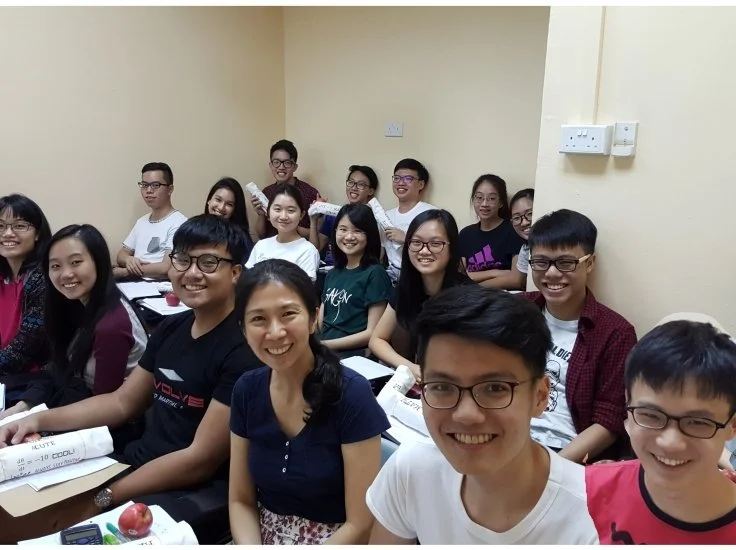
The 70-point UAS system has raised the stakes for every H2 subject, with H2 Mathematics sitting at the centre for anyone targeting quantitative courses. A slip from A to B costs 2.5 points on a 70-point scale, potentially the difference between admission and rejection for competitive programmes.
Students who invest in structured preparation, whether through consistent self-study or quality JC Math Tuition like that offered at Andrew Yap Education Centre, position themselves to maximise their options. Strong H2 Maths performance opens doors, and under the new admissions framework, that reality carries even more weight.
At Andrew Yap Education Centre, the teaching approach reflects over two decades of experience within Singapore’s most demanding institutions. Founded in 2010, the centre has helped thousands of students achieve excellence in JC H2 Maths.
The programme centres on alignment with A-Level demands, conceptual clarity before technique, and exam-focused revision strategies. Mr Andrew Yap’s experience as former Head of Mathematics at River Valley High School and Subject Head at Hwa Chong Institution means he understands how papers are set and marked at the highest levels.
Frequently Asked Questions
How is the new 70-point UAS calculated for A-Level students?
Your UAS combines rank points from three H2 subjects (a maximum of 20 each) and H1 General Paper (a maximum of 10), totalling 70 points. Your fourth subject and Mother Tongue only count if they improve your score, rebased to 70.
Is H2 Maths necessary for university admission in Singapore?
For Engineering, Computing, Data Science, and Economics at NUS, NTU, and SMU, H2 Mathematics is either a prerequisite or strongly advantageous. Even where not strictly required, a strong grade demonstrates a quantitative ability that admissions committees value.
What makes H2 Maths difficult compared to O-Level Additional Maths?
Content volume is significantly larger, with topics like Vectors being more extensive. Academic rigour increases substantially, requiring deeper conceptual understanding and three-dimensional spatial reasoning.
What rank points do I need for popular NUS and NTU courses?
For AY2025/2026, NUS Computer Science shows AAA/A at the 90th percentile. NTU Computer Science ranges from AAB/C to AAA/A, while NTU Business ranges from BBC/B to AAA/A.
When should JC students start preparing seriously for H2 Maths?
Early J1 is ideal. The syllabus builds sequentially, and gaps formed early compound over time. Students who wait until J2 face unnecessary pressure trying to learn new content while repairing foundational weaknesses.