

Many people assume that students who already score well no longer need extra academic support. In Singapore, that is rarely the case.
High-performing students often continue attending math tuition not because they are weak in the subject, but because the margin between strong and exceptional results is extremely small.
One or two marks can affect rankings, placements, and academic opportunities. A careless error, incomplete working, or poor time management can make the difference between a distinction and a near miss.
That is why math tuition in Singapore is not seen only as a fallback for struggling students. For many top performers, it is a way to maintain consistency, sharpen exam technique, and stay competitive in a demanding system, and it is why centres like Andrew Yap Education Centre design their programmes not around catching students up, but around helping strong students perform more reliably.
Key Takeaways:
- Top students use math tuition to improve precision, speed, and exam execution, not just understanding.
- Singapore’s competitive academic environment means small mistakes can have significant consequences.
- Personalised feedback helps strong students identify subtle weaknesses that are easy to miss in school.
- Math tuition supports long-term consistency, confidence, and stronger exam performance.
The Academic Pressure Behind Math Tuition Singapore

Singapore’s education system is known for being rigorous, structured, and highly competitive. National examinations such as the PSLE, O-Levels, and A-Levels continue to play a major role in determining academic progression and school placement.
Although the PSLE scoring system was revised in 2021 to reduce fine differentiation, competition has not disappeared. Students are still aiming for placement into strong secondary schools and junior colleges, and mathematics remains one of the most important scoring subjects in that journey.
Singapore’s strong performance in international benchmarking also reflects the high standards students are expected to meet. In PISA 2022 mathematics, Singapore ranked first globally with a score of 575, and 41% of students reached the top performance levels, far above the Organisation for Economic Co-operation and Development (OECD) average of 9%.
In practical terms, that pressure shows up in several ways:
- Small differences in marks can still affect placement outcomes
- Top schools receive more qualified applicants than available spaces
- Mathematics heavily influences overall academic results
- Strong students are often competing against equally strong peers
As a result, doing “well” is not always enough. The real question becomes whether a student can continue performing at the highest level, paper after paper, under exam pressure.
That is where math tuition becomes relevant for top students. It is not always about catching up. Often, it is about staying sharp.
Math Tuition in Singapore Is Not Just for Struggling Students

A common misconception is that tuition is only meant for students who are behind. In Singapore, that view no longer reflects reality.
Private tuition has become a normal part of academic life across many performance levels. According to Singapore’s Department of Statistics Household Expenditure Survey released in December 2024, families spent $1.8 billion on private tuition in 2023.
Earlier studies also estimated that a large proportion of both primary and secondary school students attended some form of private tutoring.
This matters because it changes how tuition is viewed. Instead of asking whether a child is struggling, many families are asking different questions:
- How can strong results be sustained?
- How can careless mistakes be reduced?
- How can a student stay ahead in a competitive cohort?
- How can exam performance become more consistent?
That shift moves tuition from remediation to optimisation.
How Math Tuition Helps Top Students Achieve Academic Precision
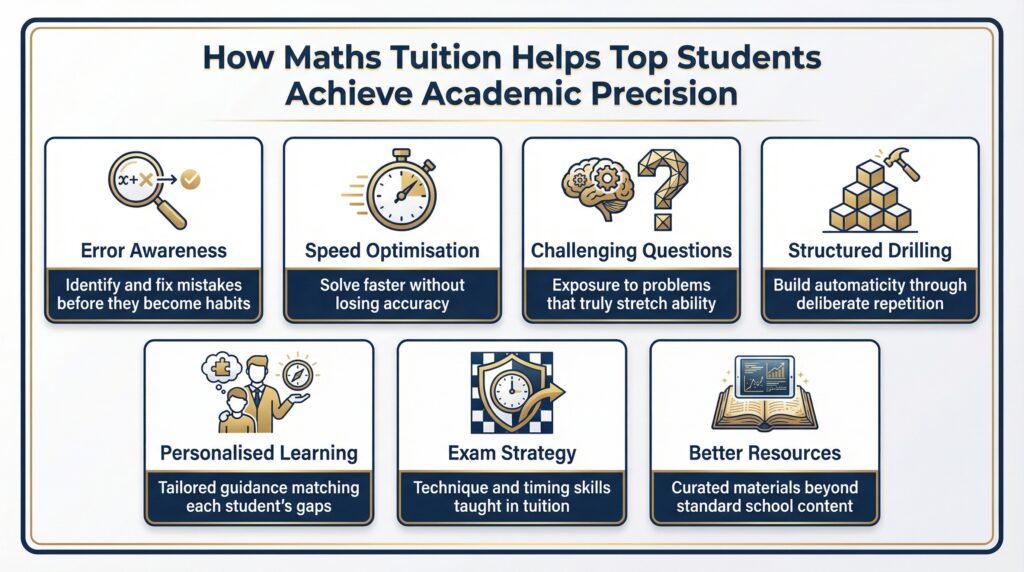
For strong students, tuition is usually less about learning a topic for the first time and more about refining how that knowledge is applied under pressure.
In many cases, top students do not lose marks because they lack understanding. They lose marks through execution errors: a skipped step, a sign error, an incomplete final answer, or inefficient time allocation. These are small mistakes, but in competitive exams, small mistakes matter. This is where the teaching approach at Andrew Yap Education Centre begins — not by reteaching what students already know, but by identifying how they apply that knowledge under exam conditions, and correcting what goes wrong.
1. It Builds Error Awareness
Doing more questions does not always lead to better results if the same mistakes keep repeating.
High-level tuition often focuses on structured error analysis. Mistakes are reviewed by type, whether conceptual, procedural, or careless. Patterns are tracked across multiple papers so students can see where marks are consistently being lost.
This creates a more useful mindset. Instead of asking how many questions were completed, the better question becomes: which mistakes were eliminated this week?
That shift helps students improve with intention rather than volume alone.
2. It Improves Speed Without Sacrificing Accuracy
Speed in mathematics is not about rushing. It is about solving efficiently while maintaining control.
In timed exams, students are not only answering questions. They manage time, decide which methods to use, and stay calm under pressure. Even strong students can struggle if they have not trained specifically for this.
Math tuition helps by developing practical exam skills such as:
- Recognising question types quickly
- Choosing efficient solution methods
- Managing time by mark weightage
- Maintaining clarity while working under pressure
Regularly timed practices help strong students become faster without becoming careless.
3. It Exposes Students to Higher-Difficulty Questions
If practice only stays within comfortable territory, improvement eventually plateaus.
One of the biggest advantages of structured tuition is access to more challenging and less predictable questions. These may include:
- Multi-step problems that combine several concepts
- Variations of standard question types
- Non-routine questions that test adaptability
- Harder exam-style questions based on past trends
This kind of exposure matters because real exams do not always test students in familiar ways. When students have already worked through harder variations, standard questions feel more manageable and less intimidating.
4. It Strengthens Fluency Through Deliberate Drilling
At the top level, fluency matters. For techniques such as algebraic manipulation, calculus procedures, or standard geometry methods, students benefit from reaching a point where the basics feel automatic.
That automaticity comes from structured, targeted drilling rather than broad, unfocused worksheets.
Effective tuition usually includes:
- Practice sets focused on specific skills
- Repeated exposure to high-risk question types
- Timed drills for speed and control
- Immediate correction before bad habits become fixed
The goal is not blind repetition. The goal is confident, reliable execution.
Why Personalised Learning Matters
A school classroom has to move at a pace that works for the majority. Even in strong schools, teachers are managing large classes and broad syllabus coverage. According to MOE’s 2024 Education Statistics Digest, average class sizes remain above 30 students at both primary and secondary levels.
That structure works well for general instruction, but it is not always ideal for students whose weaknesses are subtle.
A tuition setting can offer advantages such as:
| School Setting | Math Tuition Setting |
| Standardised pacing | Adaptive pacing based on performance |
| Limited individual feedback | Immediate, targeted feedback |
| Broad syllabus coverage | Focused skill refinement |
| One general teaching approach | Strategies tailored to the student |
For high-performing students, this matters because weaknesses are often not obvious. A student may understand the topic well but still lose marks through inefficient methods, inconsistent presentation, or avoidable carelessness. Those issues are easier to identify and correct in a more focused setting. At Andrew Yap Education Centre, the medium-group teaching format is structured to allow our tutors to catch subtle execution gaps in real time — before they become exam-day habits.
A Real Example of Where Marks Are Lost

A student preparing for O-Level Mathematics may already be scoring around 85% in school assessments. On paper, that appears strong. But a detailed review can reveal a different picture.
In one common pattern, the student may fully understand the algebra involved, yet still lose marks because:
- Negative signs are dropped during expansion
- Final answers are left in the wrong form
- Key working steps are omitted
- Careless reading leads to incomplete responses
None of these issues requires a full reteaching of the topic. They require tighter execution.
When those micro-errors are tracked, corrected, and revisited under timed conditions, results often become more stable. This is the difference between knowing mathematics and performing well in the exam — and it is the kind of session-by-session error correction that our tutors at Andrew Yap Education Centre are specifically trained to deliver.
Common Misconceptions About Math Tuition Singapore
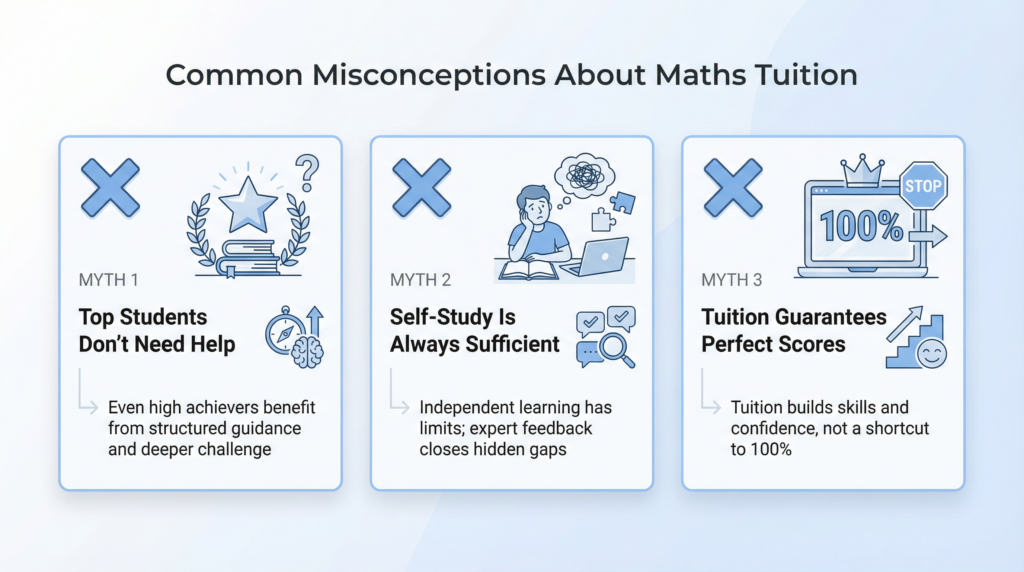
Several assumptions still shape how families think about tuition, especially for strong students.
“Top students do not need tuition.”
Strong results do not mean there are no weaknesses. They often mean the weaknesses are smaller, subtler, and harder to detect. These can still cost valuable marks in major exams.
“Self-study is enough.”
Self-study is important, but feedback matters. Without external review, students may keep repeating the same inefficient methods or careless habits without realising it.
“Tuition guarantees perfect scores.”
Tuition is not a shortcut, and it does not guarantee outcomes. What it provides is structure, sharper feedback, and more targeted practice. The student’s consistency and effort still matter.
The real value of tuition lies in how strategically it is used.
Looking for the Right Math Tuition Singapore

Families looking for math tuition should not focus only on popularity or volume of materials. The more important question is whether the programme is designed to help strong students improve precision, strategy, and consistency.
That means looking for a centre that can:
- Identify subtle performance gaps
- Provide personalised feedback
- Train students for exam conditions
- Challenge students beyond standard school practice
- Support long-term academic consistency
This is where Andrew Yap Education Centre stands out. We are known for our strong mathematics programme and structured teaching approach. Our focus is not just on helping students complete more questions, but also on sharpening accuracy, improving speed, and handling demanding problems with confidence.
For students aiming to maintain or improve top-tier results, the goal is not simply more practice. The goal is better performance under real exam conditions. Andrew Yap Education Centre is built around that objective.
Frequently Asked Questions
How often should a student attend math tuition in Singapore?
The ideal frequency depends on the student’s goals and academic level. Most high-performing students attend once or twice a week to maintain consistency without burnout. During exam periods, some increase sessions temporarily for targeted revision and practice.
What qualifications should a good math tuition teacher have?
A strong tutor should have both subject mastery and teaching experience, ideally with a proven track record of helping students achieve distinctions. Familiarity with the Singapore syllabus and exam formats is essential. More importantly, they should be able to explain complex concepts clearly and adapt to different learning styles.
Can math tuition help with problem-solving skills, not just exams?
Yes, effective math tuition focuses on developing logical thinking and structured problem-solving, not just memorising methods. Students are trained to approach unfamiliar questions with confidence. This builds skills that extend beyond exams into higher education and real-world applications.
Is online math tuition as effective as in-person classes?
Online math tuition can be effective if it includes interactive teaching, real-time feedback, and structured materials. However, some students benefit more from in-person sessions due to fewer distractions and better engagement. The effectiveness depends on the student’s learning style and the quality of instruction.
How do parents know if math tuition is actually working?
Progress should be measured through improved accuracy, faster completion of questions, and stronger confidence in tackling complex problems. Regular assessments and tutor feedback are key indicators. Consistent or improving school results also signal that the tuition approach is effective.